
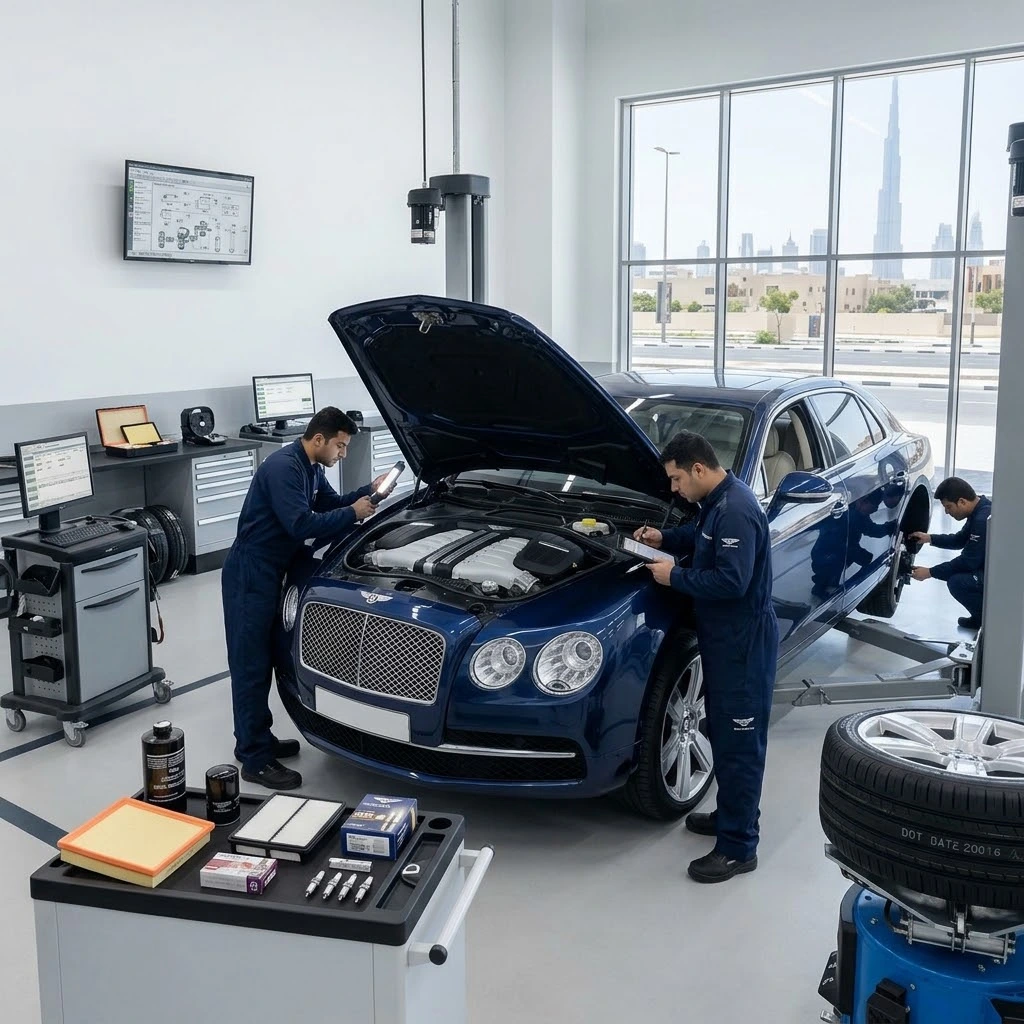
Bentley Flying Spur Problems and the Service Intervals Owners Miss
Most Bentley Flying Spur problems in Dubai are not dramatic failures. They are time-based items — brake fluid, coolant, spark plugs, tyres — that never came due on mileage, because the car covers a few thousand kilometres a year. Here are the faults by generation, the real service intervals, and what heat and dust change.
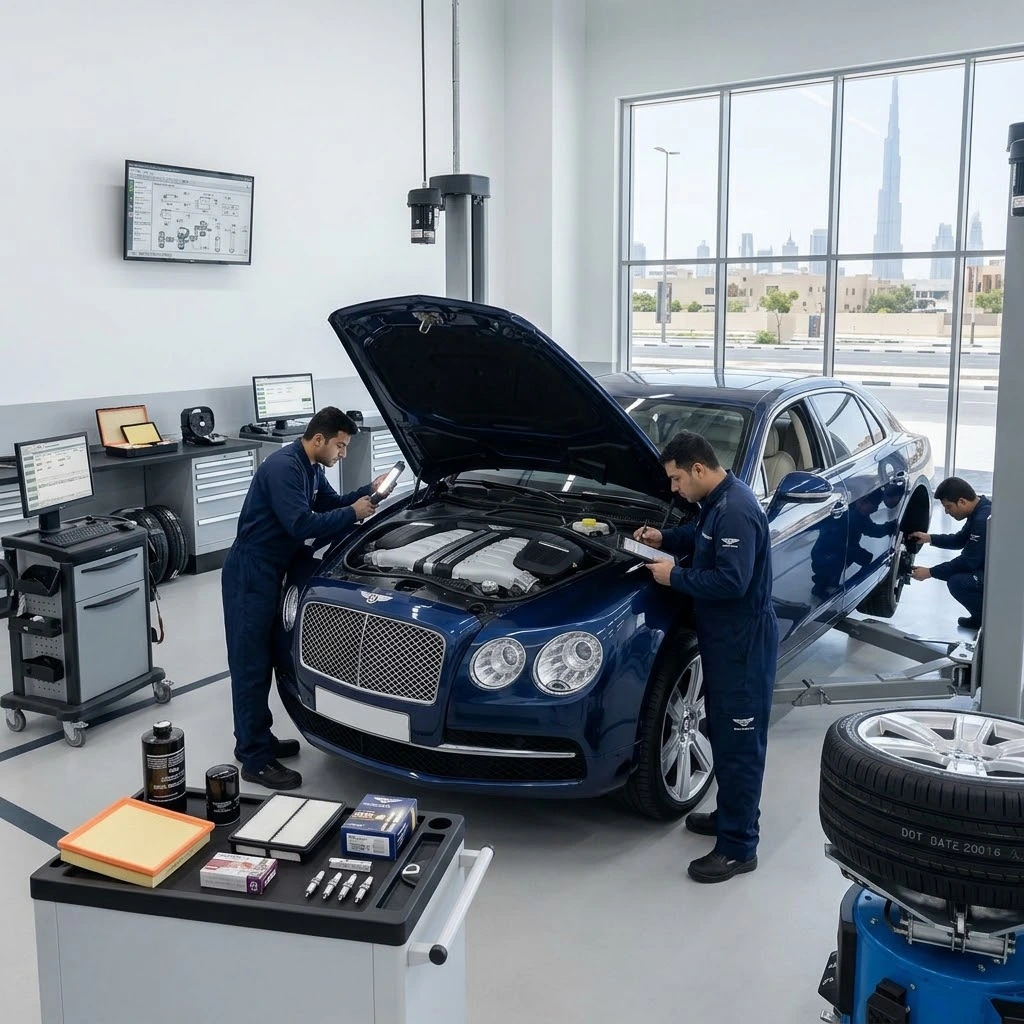
Flying Spur faults by generation: 2005–13, 2013–19 and 2019 on
Owners on UK, US and UAE forums describe three quite different cars: the early W12 is mechanical with awkward access, the second generation is mostly fluids and plastics, the third is electronics. This map comes from owner threads, repair videos and used listings, not a brochure.
| Generation | What owners report most often | First thing to check |
|---|---|---|
| 2005–13 W12, 6-speed auto | Cracked plastic vacuum pipes behind the engine; ignition coil misfires; air spring leaks; water reaching the footwell through blocked cowl drains, killing modules | Idle quality, ride height after standing overnight, dry carpets |
| 2013–19 W12, V8 from 2014, 8-speed auto | Air suspension leaks and an overworked compressor; plastic coolant pipe, thermostat housing and expansion tank leaks; valve cover and turbo oil line weeps; infotainment units stalling on the logo | Coolant level between services, ride height, screen boot-up |
| 2019 on Porsche MSB platform, dual-clutch | Flat 12V batteries and parasitic drain; infotainment freezing or rebooting; heated and cooled seats; few mechanical complaints | Battery age, software version, outstanding recalls |
Owners repeat one warning about the older cars: small parts need large jobs, because the W12 fills its bay. Advice also conflicts on spark plugs — Bentley's menu schedule says years 3, 6 and 9, parts suppliers commonly say four. On a twelve-coil engine, take the shorter figure.
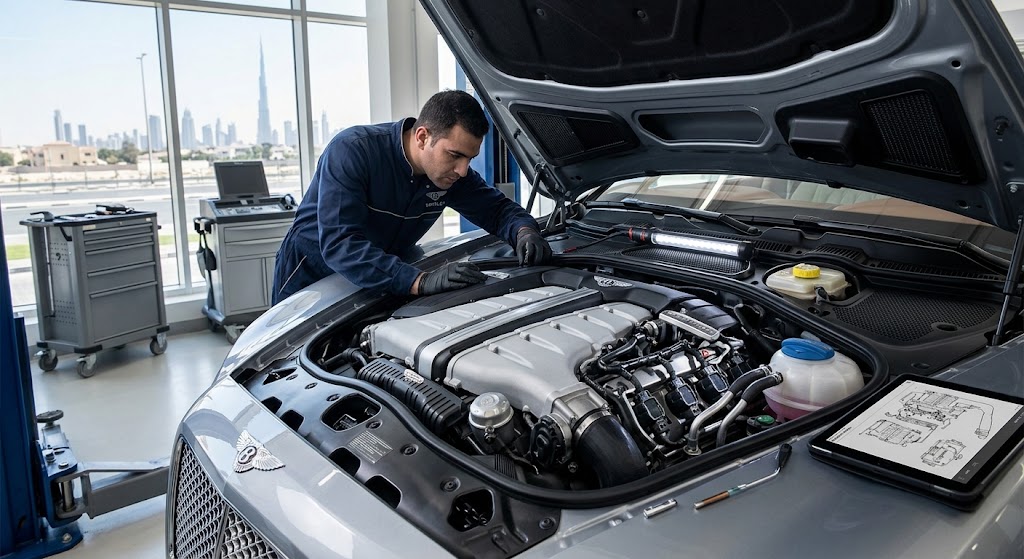
What Flying Spur owners in Dubai let slip
Almost every Flying Spur we're asked about here does low annual mileage. That is the trap: the 10,000-mile trigger takes four or five years to arrive, so mileage items stay fresh while the dated ones quietly expire. The ones that get missed:
- Brake fluid. Two years, full stop. It absorbs moisture from the air, and coastal humidity here does not help.
- Engine coolant. Five years. Old coolant loses its corrosion inhibitors while the plastic housings around it heat-cycle every summer.
- Air and pollen filters. Two-year intervals — optimistic for a car parked outdoors or taken out of town.
- The 12V battery. Under-bonnet temperatures above 60°C age a battery several times faster than its rating assumes. UAE workshops generally expect two to three years from a standard battery, a little more from AGM.
- Tyres. The RTA will fail a car whose tyres are more than five years old from the date code, regardless of tread. A low-mileage Flying Spur reaches that limit with plenty of rubber left.
- Gearbox oil. Not on the menu schedule, but ZF, who build the boxes, advise a change at eight years or 100,000 km.
- TPMS sensor batteries. A standard check item, and a common cause of a warning light that never clears.
Bentley Flying Spur service intervals by mileage and time
Bentley alternates a minor service every 10,000 miles (16,000 km) with a major every 20,000 miles, plus items fixed by year. Several UAE workshops quote 10,000 km instead — shorter, and in our view right for this climate.
| Item | Bentley's published schedule | What we'd do in Dubai |
|---|---|---|
| Oil and filter (minor service) | 10,000 miles (16,000 km) or 12 months | 10,000 km or 12 months |
| Major service | 20,000 miles, or years 4, 6, 8, 10 | Go by the year count; the mileage rarely arrives |
| Brake fluid | Every 2 years | Every 2 years, no extension |
| Engine coolant | Every 5 years | 4–5 years, sooner if it has been topped up |
| Spark plugs | Years 3, 6, 9 | Same, and test all twelve coils on a W12 |
| Air filter | Years 2, 4, 6, 8 | Yearly if parked outside or driven off-road |
| Pollen filter | Every 2 years | Yearly |
| Fuel filter | Years 5, 10 | Same |
| Gearbox oil | Not in the menu schedule | ZF's own advice: 8 years or 100,000 km |
| Tyres | Condition and pressure at every service | Replace at 5 years from the date code (RTA rule) |
Typical case: the low-mileage car that never triggered a service
A typical case looks like this. A 2016 W12 covers 5,000 km a year and sits in a garage through July and August while the family travels. The mileage service never comes due, so the car is looked at "when it needs it". By year six the coolant is original, the brake fluid is on its first fill, and the battery is four years old.
What we'd expect to find: coolant past its inhibitor life in plastic housings heat-cycled through six summers, brake fluid carrying moisture, and a battery that starts fine in February and fails in June. The expensive version is a split expansion tank on a summer motorway run, and an overheated W12 is a serious conversation.
Estimate: renewing coolant, brake fluid and a battery together is a few hours of workshop time on one visit. A head gasket on a W12 after an overheat is an engine-out job measured in days. Contact us for a current quote on either.
What to do right now
- Read the date code on all four tyres — four digits, week then year. Over five years, the car fails its RTA test.
- Check the service book for the last brake fluid and coolant dates, not the last mileage.
- Look at the car after it has stood overnight. One corner low means an air spring leak, and that leak eventually burns out the compressor.
- Pull back the passenger carpet edge and feel for damp. Wet means blocked cowl drains, and on older cars, modules at risk.
- If the battery is over two years old, have it load-tested before the summer rather than after a no-start.
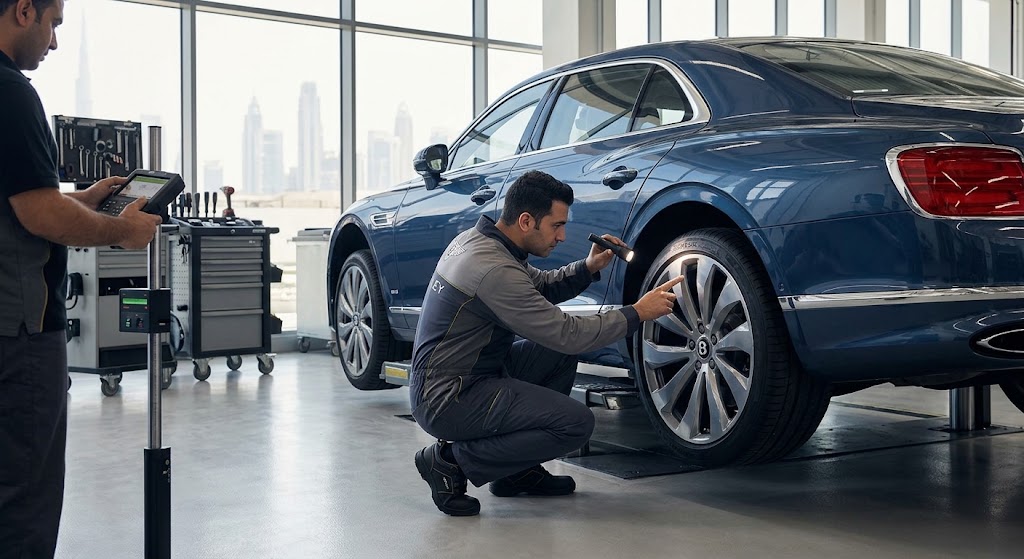
Flying Spur questions owners ask us
How often should a Bentley Flying Spur be serviced?
Bentley's schedule is a minor service every 10,000 miles (16,000 km) or 12 months, with a major service every 20,000 miles. In Dubai we'd work to 10,000 km or 12 months, whichever comes first, and treat the annual visit as non-negotiable even on a car that barely moves — brake fluid, coolant and filters expire on time, not on distance.
Which Flying Spur generation has the fewest issues?
For most owners we'd take a 2016–2019 V8: the early cars' vacuum pipe and coil problems are largely behind it, and the 4.0 V8 is far easier to work on than the W12. The 2019-on cars are mechanically the strongest of the three, but their common complaints are battery and software faults rather than anything you can spot in a car park.
What do Flying Spur owners most commonly overlook?
Brake fluid and coolant, because both are dated rather than metered, and tyre age, because a low-mileage car looks fine on tread while its date code has expired. On pre-2013 cars, the blocked drains under the windscreen are the other one — cheap to clear, expensive to ignore.
Is the W12 or the V8 the better choice in Dubai heat?
Both run hot; the difference is access. On a W12 a small coolant or vacuum component can mean lowering or removing the engine, so a minor leak becomes a major invoice. The V8 leaves more room to work and uses less fuel in city traffic. If you want the W12 character, buy one with documented cooling and vacuum work already done.
Book a Flying Spur inspection in Dubai
Free pickup and drop-off across Dubai, with a written report on what is due by date, not just mileage.