
Bentley Air Suspension Failure: Repair It or Replace It?
A Bentley sitting low after a night parked is the classic sign of air suspension failure, but a low corner doesn't automatically mean a new strut. Here's how to tell strut from compressor from valve block, and which fix makes sense in Dubai heat.

Continental GT/GTC (2004 on), Flying Spur, Bentayga, Mulsanne.
A corner low after standing, plus a "too low" warning.
Drive gently only if it rises and the warning clears.
Genuine, used genuine, re-bagged, aftermarket.
A typical case: the Continental GT sitting low one morning
Typical case: a 2012–2018 Continental GT on its original struts, about ten years old. In the morning the front-left arch sits visibly closer to the tyre than the right. On start-up a "too low" warning appears, then clears once the car levels. Next morning, the same.
Owners on UK and US Bentley forums describe this pattern more than any other. It means a slow leak, not necessarily a failed strut. Bentley's own air spring fault-finding bulletin says a dropped car doesn't automatically have a faulty air spring, and some leaks at brass fittings and air pipes can be fixed without a new strut.
Bentley air suspension symptoms: strut, compressor or valve block?
Three main failure points, joined by pipes that can also leak.
The air strut
A rubber air spring around the damper at each corner. It leaks: a slow sag at one corner, sometimes a hiss at the wheel. A worn damper inside makes the ride harsh or floaty.
The compressor
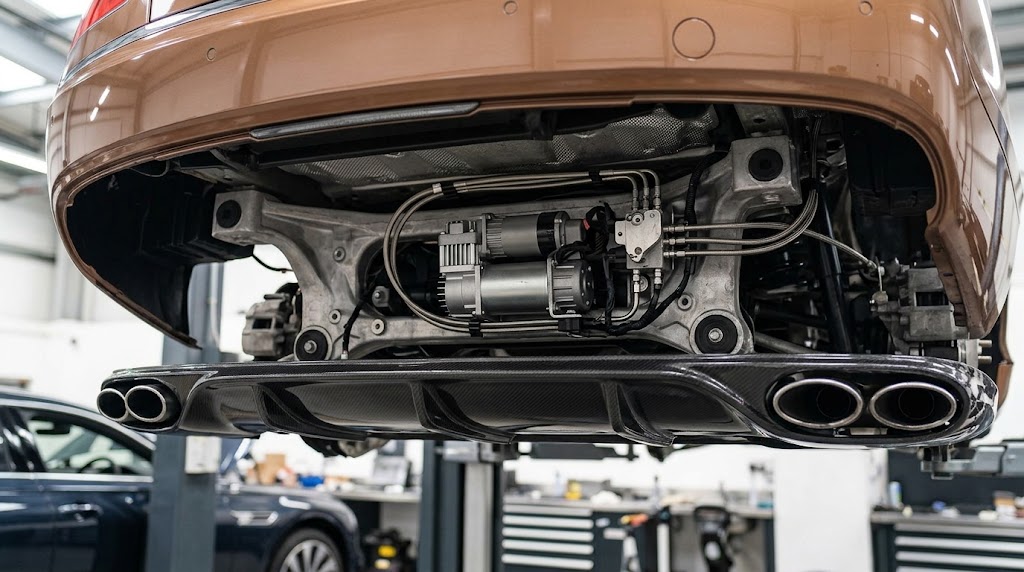
Under the rear of the car, above the diffuser. It rarely fails first; it usually wears out chasing a leak elsewhere. It has a thermal cut-out, so after running too long it simply stops, sometimes without a dash warning, and the car rises slowly or not at all.
The valve block
It routes air to each corner. Faults show as one corner that won't lift while the compressor runs, or pressure that builds then falls away.
The 60-second at-home check
- Before starting, compare the tyre-to-arch gap at each corner. Photograph it.
- Start the engine and time how long the compressor runs.
- Note the exact dash message and whether it clears.
| What you see | Most likely cause |
|---|---|
| One corner low overnight, rises normally | That corner's strut or air fitting |
| Both wheels on one axle low | Both struts ageing together, or a shared pipe |
| All four slightly lower after a hot day | Normal: the air has cooled |
| Long compressor run, slow or partial rise | Worn compressor, or thermal cut-out from a leak |
| Compressor runs, one corner won't lift | Valve block or that corner's pipe |
| Silence at start-up and nothing rises | Compressor relay, fuse or wiring |
| All four drop while driving | Compressor, main pipe or valve block: stop and arrange recovery |
Copy Bentley's own leak test. On level ground, run a strip of masking tape taut from each wheel centre to the top of its arch and measure the gaps. Check next morning: a slack strip or a shrunken gap marks a real leak at that corner. If all four hold, the drop was temperature, not a fault.
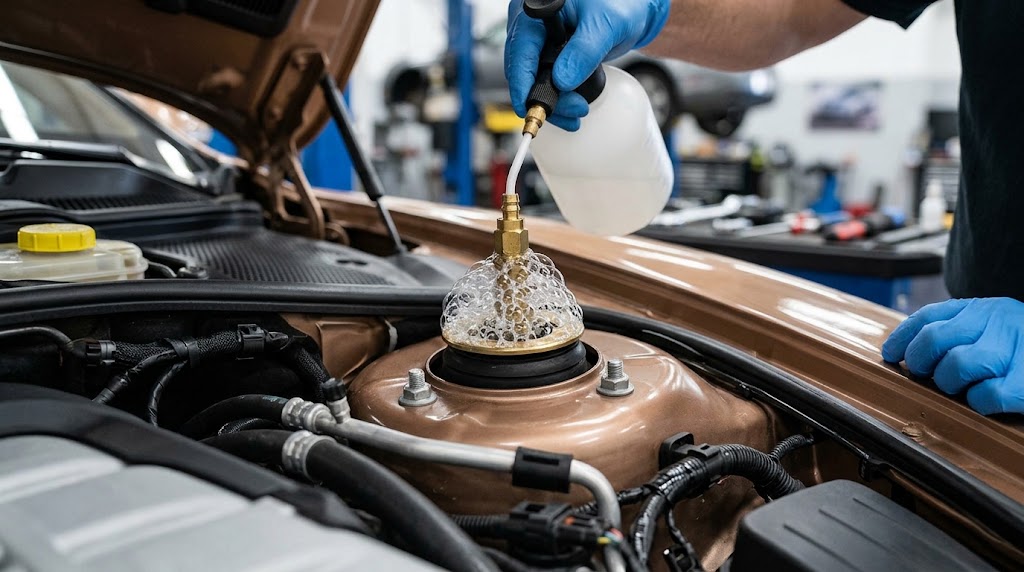
Bentley air suspension repair cost: fix, genuine or aftermarket strut
Part prices move and the right option depends on what failed, so contact us for a current quote. Here's how the options compare.
| Option | Relative cost | Keeps adaptive damping? | Best for | Watch out for |
|---|---|---|---|---|
| Repair a leaking fitting or air pipe | Lowest | Yes | Leak at a brass union or pipe | Only works if the fitting is proven as the source |
| New air spring on your original damper | Low to medium | Yes | 2004–2018 cars with a healthy damper | The damper keeps its age |
| Used or remanufactured genuine strut | Medium | Yes | Older cars on a budget | Nobody knows the donor damper's mileage |
| New aftermarket strut | Medium | Depends on the unit | Budget repairs on older Continentals | Some are passive, using a resistor to hide lost damping control |
| New genuine Bentley strut | Highest | Yes | 2018-on cars and Bentayga | Price |
Whichever part you choose, replace struts in axle pairs: the other side is the same age. On older Continentals the upper links are often worn when the struts come out, so renew them then. And ride height must be calibrated with a diagnostic tool afterwards.
The 2018-on Continental GT moved to three-chamber air springs with 60% more air volume. Established aftermarket struts are built mainly for the 2004–2019 cars, so genuine parts dominate on newer ones.
What Dubai heat does to rubber air springs
Air spring maker ContiTech says heat, ozone and UV speed up rubber wear, and a nearby exhaust adds more. The UAE hit 51.8°C in Sweihan on 1 August 2025; Dubai spends much of summer in the mid-40s.
Heat also causes false alarms. Estimate: air cooling from 45°C to 30°C overnight loses about 5% of its pressure (318 to 303 kelvin), so a healthy car can sit slightly lower on all four corners after a hot day or in a cold basement car park. Bentley's bulletin treats this as normal; the compressor re-levels on start-up. One corner lower than the rest is not temperature.
Summer travel is the other risk. A car left for weeks can settle onto its bump stops, and ageing rubber folded while deflated may not unfold cleanly; inflating a creased spring can tear it. Back to a car on the ground? Let it rise fully before moving; if a corner stays down, get it checked. And because the compressor's cut-out trips sooner when everything underneath is hot, a leak that's harmless in winter can leave the car low mid-drive in July.
What we'd recommend for a leaking Continental GT strut
For the typical case above, one front strut leaking on a ten-year-old Continental GT, this is what we'd advise most owners:
- Prove the leak first. If the brass fitting is the culprit, repair it and stop there.
- If the strut leaks, replace both fronts. The other side is the same age and will follow.
- Keep the adaptive damping. Genuine new if budget allows; otherwise used genuine, or aftermarket that keeps full damping control. On a daily car we'd avoid passive struts.
- Check the compressor and links, then calibrate. A new strut on a worn-out compressor just moves the failure.
For a 2018-on Continental GT, Flying Spur or Bentayga, we'd go genuine.
Air suspension questions owners ask us
How do I know it's the strut and not the compressor?
A strut leak shows as one corner or axle sagging after standing while the car still rises normally. A compressor fault shows as slow or no lifting everywhere, unusually long run times, or a drop while driving. Leaking struts often wear out compressors, so test both.
Is an aftermarket air strut safe on a Bentley?
A quality unit, fitted and calibrated properly, is safe. But some aftermarket struts are passive and drop variable damping, and owners report uneven quality such as clunks or early sagging. Ask what the part retains before it's fitted.
How long will a Bentley air suspension repair last?
A UK Bentley parts specialist puts air suspension parts at 6–10 years; owners often report about ten from original struts. Aftermarket air springs commonly carry 2–3 year warranties. Our view: in Dubai heat, plan for the shorter end.
Can I drive my Bentley when it's sitting low?
If it rises to normal height and the warning clears, a short, gentle drive to a workshop is generally fine. If it stays low or the warning won't clear, don't drive: tyres can rub the arches and the compressor can burn out. Arrange recovery instead.
Bentley sitting low? Find the leak before you buy a strut
Send us a photo of the low corner and the dash message, and we'll arrange free pickup anywhere in Dubai for a proper leak test.