
Bentley Exhaust & Catalytic Converter Repair in Dubai | Bentley Repairs Dubai
A deep drone at idle, a rattle over speed bumps, a warning light after a cold start, or a sudden loss of that composed Bentley note — these are the moments that bring owners to us. We are an independent Bentley exhaust and catalytic converter specialist covering the whole of Dubai, delivering dealer-level workmanship at a fraction of authorised dealership prices, with free pickup and drop-off anywhere in the emirate.
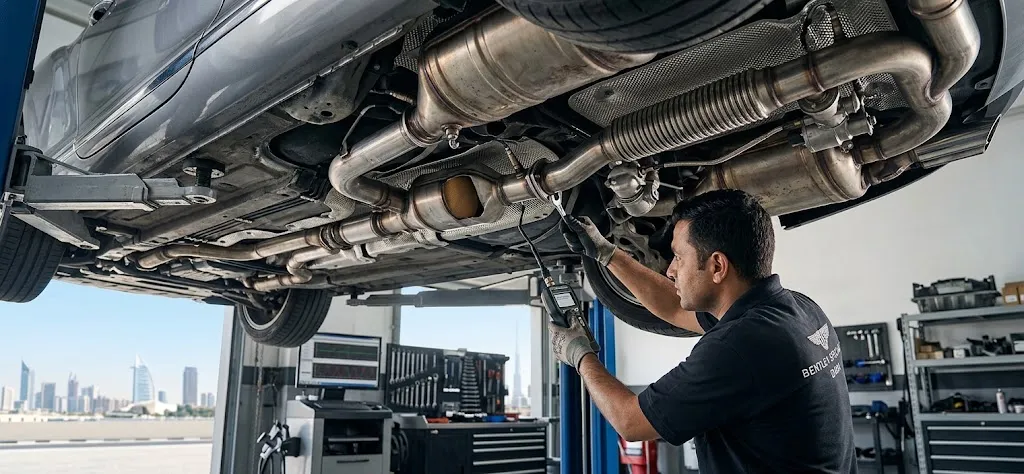
Bentley exhaust and catalytic converter work, done properly, at an independent price
The exhaust system on a modern Bentley is not a simple set of pipes. On a Continental GT or a Flying Spur it is a tuned, multi-stage assembly with active valves, close-coupled catalytic converters, oxygen sensors feeding the engine management, and heat shielding that has to survive twin-turbo temperatures. On the older 6.75-litre cars — the Arnage, the Mulsanne, the Azure and the Brooklands — it is a beautifully engineered but genuinely heavy stainless assembly that rewards careful, unhurried work. Get any part of it wrong and the car either sounds wrong, runs rich, throws fault codes, or fails to deliver the effortless torque a Bentley is supposed to make.
We are Bentley Repairs Dubai, an independent Bentley specialist workshop. To be completely clear from the outset: we are not an authorised Bentley dealership, and we never suggest otherwise. What we are is a focused, experienced team that works on Bentleys day in and day out, using dealer-level diagnostic equipment and the same procedures a franchised workshop would follow — but without the overheads that push dealer invoices to eye-watering levels. For most exhaust and catalytic converter jobs, our customers pay up to 70% less than they would at the authorised dealer for equivalent work.
Being independent brings a second advantage that matters just as much on exhaust work: choice. We can source genuine (OEM) Bentley parts, high-quality aftermarket components, or carefully inspected used parts, and we talk you through the trade-offs honestly before anything is ordered. A perfect original catalytic converter from a low-mileage donor car can save you thousands over a new dealer unit, and for a rear silencer or a heat shield, a good aftermarket part is often indistinguishable in service. You decide; we advise.
Anywhere in Dubai, we come to you. Book a free collection and we will pick your Bentley up from home, office or valet, carry out the exhaust or catalytic converter work at our workshop, and return the car to you cleaned and tested. No trailer fees, no "recovery" charges, no fuss — it is simply part of how we work.
What Bentley exhaust and catalytic converter repair actually involves
"Exhaust repair" covers a wide range of jobs, and on a Bentley the range is wider than most, because the system does several jobs at once: it channels gases away from the engine, cleans them through the catalytic converters, controls sound through resonators and silencers, and — on the sportier cars — changes character on demand through electronically actuated valves. When you bring a car to us, we identify which part of that chain has failed rather than replacing everything on principle. Here is what the work typically covers.
The catalytic converters
Every petrol Bentley runs three-way catalytic converters that convert unburnt hydrocarbons, carbon monoxide and oxides of nitrogen into far less harmful gases. On the W12 and V8 Continental and Bentayga models these sit close to the turbochargers, which means they run hot and are subject to real thermal stress. A converter can fail in two broad ways: the internal ceramic honeycomb can crack or crumble (often heard as a loose rattle, or felt as a sudden loss of power and a rich-running fault), or the catalyst material can degrade so that emissions and downstream oxygen-sensor readings drift out of range, triggering a check-engine light and a catalyst-efficiency fault code. We diagnose which of these has happened before recommending a replacement, because a converter that is merely reading low can sometimes be traced to an upstream problem — a leaking injector, a misfire, or a failing sensor — that would destroy a brand-new converter within weeks if left unaddressed.
Exhaust leaks and joint failures
Leaks develop at gaskets, flange joints, welded seams and flexible sections. On the twin-turbo cars, the manifold-to-downpipe area sees the highest temperatures and is the most common leak point; a blown gasket there produces a distinctive ticking or hissing that rises with engine load. Elsewhere, corrosion is less of an issue in Dubai's dry climate than in humid or salted-road markets, but heat cycling still fatigues joints and flexi-pipes over the years. We pressure-test and smoke-test the system to pinpoint leaks precisely rather than chasing noises by ear.
Rattles, knocks and heat-shield noise
Not every rattle is a dying catalytic converter. Loose or fatigued heat shields, worn rubber hangers that let the system swing and contact the underbody, and broken internal baffles in a silencer all produce rattles that owners understandably fear are something worse. Part of a good diagnosis is separating a cheap fix (a new hanger, a re-secured shield) from an expensive one, and we always look for the cheap answer first.
Exhaust valve and flap faults
Many performance Bentleys use vacuum- or electrically-actuated valves in the rear silencers to switch between a quiet, refined cruise and a fuller, sportier voice. When these stick, seize or lose their actuation, the car can end up stuck loud (an embarrassing constant drone) or stuck quiet (a muffled, flat character that owners immediately notice). Faults here can be mechanical seizure, a failed actuator, a split vacuum line, or a control fault — and each has a very different cost. We test the valves under command to establish exactly where the fault sits.
Silencers, resonators and back-boxes
The rear silencers and resonators shape the final character of the exhaust note and keep it civilised at cruise. Internal baffles can corrode or come loose over time, changing the tone or adding a buzz. Replacing a back-box is straightforward mechanically; the skill is in sourcing the right part and preserving the factory sound signature that makes a Bentley sound like a Bentley.
Sensors and emissions-related components
Oxygen (lambda) sensors, both upstream and downstream of the converters, are integral to how the engine meters fuel and how the car self-monitors its emissions. A lazy or failed sensor can mimic a catalytic-converter fault, so it is essential to read live sensor data before condemning an expensive converter. We also address the mounting bungs, wiring and connectors that these sensors depend on.
Sports and upgraded exhaust fitting
For owners who want more presence — a deeper, sharper voice, or a lighter system — we fit sports and upgraded exhausts to suit. We advise on reputable systems, handle the fitment cleanly, and make sure valve control and sensor placement remain correct so the car still runs and reads properly afterwards. If you love your Bentley's manners but want a little more theatre, this is very much within our remit.
Warning signs your Bentley needs exhaust or catalytic converter attention
Bentleys are engineered to insulate you from mechanical drama, which is exactly why the early symptoms of an exhaust problem are easy to dismiss. By the time a problem is obvious, it has often been developing for a while. If you notice any of the following, it is worth a conversation.
A rattle at idle or over bumps
A loose, marble-like rattle from underneath — most obvious at cold start, at idle, or over speed bumps — often points to a broken catalyst substrate or a loose heat shield. It rarely fixes itself.
A check-engine or emissions light
Catalyst-efficiency codes, lambda-sensor codes and rich/lean running faults frequently trace back to the exhaust and emissions system. The light deserves a proper diagnostic read, not a reset.
A new drone, hiss or ticking
A hiss or ticking that rises with load suggests a leak, often near the manifolds. A constant drone at cruise can indicate a stuck exhaust valve or a failed silencer baffle.
Loss of power or hesitation
A collapsed or partially blocked catalytic converter restricts flow, choking the engine. The car feels flat, sluggish and reluctant to pull — unmistakable in a machine that normally surges forward.
A smell of exhaust fumes
Catching a whiff of exhaust in or around the cabin means gases are escaping before the tailpipe. This is a safety issue as much as a mechanical one and should be checked promptly.
Poor fuel economy or a sulphur smell
A failing converter or a rich-running fault can worsen consumption and produce a rotten-egg smell. Both point to something in the emissions chain that needs investigating.
None of these symptoms tells you, on its own, exactly what has failed — that is what a proper diagnosis is for. But all of them are reasons to stop guessing and get the car assessed before a small problem becomes a converter-destroying one.
Our diagnostic and repair process, step by step
Exhaust and catalytic converter work goes wrong most often not in the fitting but in the diagnosis — replacing a converter that was never the problem, or missing an upstream fault that ruins the new part. Our process is built to prevent exactly that.
1. Listen to the owner and drive the car
You know your Bentley better than any scanner does. We start by listening to what you have noticed — when it happens, at what temperature, at what speed — and then we road-test the car ourselves to feel and hear the symptom in context. A rattle that only appears at 2,000 rpm under load tells us something different from one that is constant at idle.
2. Full diagnostic scan and live data
We connect dealer-level diagnostic equipment and read the stored and pending fault codes across the engine and emissions systems. Crucially, we also watch live data — oxygen-sensor voltages, fuel trims, catalyst temperatures where available — so we can distinguish a genuinely failed converter from a sensor or fuelling fault that only looks like one.
3. Physical inspection on the ramp
The car goes up on the lift for a hands-on inspection of the entire system: manifolds and downpipes, converter housings, flexi-sections, silencers, hangers, heat shields and sensor wiring. We check for leaks, cracks, discolouration from heat, loose fixings and internal rattles, tapping and probing where needed to localise a noise.
4. Leak and flow testing
Where a leak is suspected, we smoke-test or pressure-test the system to find it precisely rather than chasing it by ear. Where a blockage is suspected, we assess back-pressure so we know whether the converter is genuinely restricted or simply reading inefficient.
5. A clear, itemised recommendation
Once we know exactly what has failed, we explain it plainly and give you options: which parts need replacing, whether genuine, aftermarket or good used components make the most sense for each, and what the realistic cost and timeframe look like. Nothing is ordered or started until you have approved the plan. No surprises appear on the final invoice.
6. The repair, done to a standard
We carry out the work using correct torque values, new gaskets and fixings, fresh heat-shield hardware where needed, and proper anti-seize on sensor threads. Welding, where required, is done cleanly and to last. On sports-exhaust fitments, we make sure valve control and sensor readings remain correct so the car is complete, not merely loud.
7. Post-repair testing and a clean handover
After assembly we clear codes, re-scan, run the engine up to temperature, re-check for leaks, and road-test again to confirm the symptom is genuinely gone — not just the warning light. The car is cleaned and, if you booked collection, driven or transported back to you. We walk you through what was done and why.
The equipment and expertise behind the repair
There is a reason experienced Bentley owners are wary of general workshops for this kind of work. A garage that mostly handles mass-market cars can physically bolt an exhaust together, but it often lacks the diagnostic depth to read a Bentley's emissions system properly, the experience to know that a particular rattle is a known heat-shield issue rather than a converter, or the patience the older 6.75-litre cars demand.
Our team works on Bentleys specifically. That focus means we recognise model-specific patterns quickly: the way the W12's close-coupled converters behave, the vacuum-actuated valve quirks on certain Continentals, the sheer weight and layout of the Arnage and Mulsanne systems, the differences between early and late Continental GT exhausts. We pair that experience with dealer-level diagnostic equipment capable of reading Bentley-specific fault codes and live parameters — not a generic code reader that only sees a fraction of what the car is reporting.
Bentley-capable diagnostics
Dealer-level scan tools that read manufacturer-specific codes and live emissions data, so we diagnose the actual fault rather than the first light that comes on.
Proper lifting and access
Full workshop lifts and the correct tooling to access, support and remove heavy exhaust assemblies safely — particularly important on the larger saloons.
Leak and flow testing gear
Smoke and pressure testing to find leaks precisely, and back-pressure assessment to confirm whether a converter is genuinely restricted.
Model-specific know-how
Hands-on familiarity with the exhaust and emissions layout of every non-electric Bentley, from the Turbo R era to the current Continental and Bentayga.
Just as important as the tools is judgement. Knowing when a fault code points to the converter and when it points upstream, when a rattle is a five-minute hanger fix and when it is a failed substrate, when a used part is a smart saving and when only new will do — that judgement is what protects you from paying for parts you never needed.
The faults we see most on Bentley exhaust systems
Across the Bentleys that come through our workshop, a handful of exhaust and catalytic converter issues account for the vast majority of visits. Understanding them helps you describe your own symptom accurately and understand our recommendation.
Exhaust leaks
Most commonly at manifold and downpipe joints on the turbocharged cars, where temperatures are highest, and occasionally at flexi-sections that have fatigued from years of heat cycling. Symptoms range from a soft hiss to a sharp ticking that rises with load. Left alone, a leak upstream of an oxygen sensor can also confuse the fuelling and trigger unrelated-looking faults, which is why we treat leaks as a priority.
Rattles
The rattle that owners fear most is a broken catalyst substrate — the ceramic honeycomb inside a converter breaking up and shaking loose. But an identical-sounding rattle can come from a loose heat shield or a perished hanger, both of which are cheap to fix. We always confirm the source before quoting, because the difference in cost is enormous.
Catalytic converter failure
Converters fail from age, from heat, or — most avoidably — from an upstream problem such as a persistent misfire or over-fuelling that cooks the catalyst. That is why we insist on checking the whole picture: replacing a converter without fixing what killed it is money poured away. When replacement is genuinely needed, we source the right part in your preferred grade, genuine or otherwise.
Exhaust valve and flap faults
On performance models, a stuck or failed valve leaves the car either constantly loud or oddly muted. The cause might be a seized flap, a dead actuator, a split vacuum line, or a control fault — and we test under command to find out which, rather than replacing the whole silencer assembly on a guess.
Sports exhaust fitting
For owners who want a stronger character, we fit quality sports and upgraded exhaust systems cleanly and correctly, preserving proper sensor function and valve control so the car still runs and reads as it should. We are happy to advise on options that suit the model and the sound you are after.
Genuine, aftermarket and used parts — your choice, our advice
One of the real benefits of using an independent specialist rather than a franchised dealer is flexibility on parts. A dealership will generally fit new genuine components and bill accordingly. We can do the same — and often do, when it is the right call — but we can also offer alternatives that save you a great deal of money without compromising the result.
Genuine (OEM) parts
Original Bentley parts are the natural choice where fit, finish and long-term reliability matter most, or where a customer simply prefers to keep the car entirely original. For certain sensors, gaskets and converter assemblies, genuine is often our own recommendation. We source these through proper channels and fit them correctly.
Quality aftermarket parts
For many exhaust components — silencers, heat shields, hangers, gaskets, some sensors — a reputable aftermarket part performs identically in service at a lower price. We only use aftermarket parts we trust, and we are honest about where they are a sensible saving and where they are a false economy.
Carefully inspected used parts
For expensive assemblies such as catalytic converters or complete rear silencer sections, a sound used part from a low-mileage donor car can save thousands. We inspect used parts thoroughly before fitting and only use ones we would be comfortable putting on our own vehicles. On an older Arnage or Azure, a good used component can be the difference between a sensible repair and an uneconomic one.
Whichever route you choose, the decision stays with you. We lay out the options, the costs and the trade-offs for each part in the repair, and you tell us how you want to proceed. There is never pressure to take the most expensive path.
Free Bentley pickup and drop-off anywhere in Dubai
An exhaust problem can leave a car sounding rough or running poorly, and nobody enjoys driving a valuable Bentley when it does not feel right — or arranging their own recovery to a workshop. So we take that out of your hands entirely. Wherever you are in the emirate, we collect the car for free, carry out the work, and return it to you.
From Downtown, Business Bay and DIFC to Dubai Marina, Jumeirah, Palm Jumeirah, Emirates Hills, Arabian Ranches, Mirdif, Al Barsha, Deira and everywhere in between, our free collection covers the whole of Dubai. You do not need to take time off, sit in a waiting room, or worry about how a poorly-running car will get to us. We handle logistics; you carry on with your day.
We come to you
Home, office, valet or building parking — tell us where the car is and we arrange collection at a time that suits you.
Work done at our workshop
The exhaust or catalytic converter repair is completed properly at our fully-equipped premises, not in a car park.
Returned tested and clean
We road-test, re-scan and clean the car, then deliver it back to you with a clear explanation of what was done.
Why Bentley owners in Dubai choose us
There are only a handful of places in Dubai you would trust with a Bentley, and for many owners the real choice comes down to the authorised dealer or a genuinely specialist independent. Here is why so many choose us for exhaust and catalytic converter work.
A true independent specialist — and clear about it
We are not an authorised Bentley dealership and we never pretend to be. We are an independent workshop that specialises in Bentley, which means the same marque focus and standards as a franchised operation, delivered by people who choose to work on these cars specifically. That honesty is the foundation of the trust our customers place in us.
Dealer-level quality without dealer-level bills
We use dealer-level diagnostic equipment, correct procedures and experienced Bentley mechanics, so the quality of the work stands comparison with the dealership. Because our overheads are lower, our prices are dramatically lower — typically up to 70% less than the authorised dealer for equivalent exhaust and catalytic converter work.
Every non-electric Bentley, from classic to current
Whether you own a current Continental GT, a Flying Spur, a Bentayga, or a cherished Arnage, Mulsanne, Azure, Brooklands or Turbo R, we have the experience and the equipment to look after its exhaust system properly.
Parts flexibility that saves you money
Genuine, aftermarket or quality used — we source whatever suits the job and your preference, and we are transparent about the cost and the trade-offs so you always make an informed choice.
Free Dubai-wide collection and delivery
No recovery charges, no logistics to arrange yourself. We collect and return your Bentley anywhere in the emirate, free of charge.
A full body shop under the same roof
Because we are a complete Bentley workshop, we also handle denting and painting, accident and collision repair, bumper repair, full body respray, and professional polishing and detailing. If your exhaust work uncovers cosmetic needs — or you simply want the car looking its best — it can all be handled in one place.
A note on how we work: all of our repairs are direct, self-pay arrangements. We do not deal with insurance companies, which keeps things simple, fast and transparent — you know exactly what the work costs and there is no third party slowing the process down or dictating which parts we may use.
Approximate cost guidance in Dubai
Every honest workshop will tell you the same thing: you cannot price Bentley exhaust work sight unseen. The cost depends on the model, on which component has failed, on whether you choose genuine, aftermarket or used parts, and on how much labour the job involves — a single heat-shield fix and a full catalytic-converter replacement sit at opposite ends of the scale. Rather than quote figures we would have to invent, here is an honest guide to the relative cost of common exhaust jobs, and to how our pricing compares with the dealer.
| Type of exhaust work | Relative cost band | What drives the price |
|---|---|---|
| Heat shield or hanger repair / rattle fix | Lowest | Minimal parts, modest labour once the source is confirmed |
| Exhaust leak / gasket / joint repair | Low to moderate | Access to the leak point, gaskets and fixings, any welding needed |
| Oxygen (lambda) sensor replacement | Low to moderate | Part grade (genuine vs aftermarket) and number of sensors involved |
| Exhaust valve / flap or actuator repair | Moderate | Whether it is a vacuum line, an actuator, or a full silencer section |
| Silencer / back-box replacement | Moderate to high | Part choice and model; genuine assemblies cost considerably more |
| Catalytic converter replacement | Highest | Model, number of converters, and genuine vs quality used parts |
Two principles hold across all of it. First, our diagnosis comes before any quote, so you never pay for parts you did not need. Second, across the board, our pricing runs substantially below the authorised dealer — up to 70% less on equivalent work — and choosing quality used parts on the bigger jobs can widen that gap further. For an accurate figure on your specific car and symptom, the quickest route is simply to call or WhatsApp us.
Bentley models we carry out exhaust and catalytic converter work on
We service the exhaust systems of every non-electric Bentley, spanning modern twin-turbo machines and the classic 6.75-litre cars. Each has its own exhaust character and its own known quirks, and we bring model-specific knowledge to all of them.
Continental GT & GTC
W12 and V8 coupes and convertibles, including close-coupled converters and active exhaust-valve systems that we diagnose and repair or upgrade.
Continental & Supersports variants
Higher-output Continentals and the Continental R & T, whose exhaust and emissions systems reward a specialist's familiarity.
Flying Spur
The performance saloon in W12 and V8 forms — converters, sensors, valves, silencers and leak repairs all handled.
Bentayga
Bentley's SUV, whose exhaust layout and emissions system we diagnose and repair with the correct dealer-level tooling.
Mulsanne
The flagship 6.75-litre saloon, with a substantial exhaust assembly that we service with the patience and lifting equipment it demands.
Arnage
A modern classic whose exhaust and converter components benefit hugely from good used-part sourcing — a real independent-specialist advantage.
Azure & Brooklands
The grand convertible and coupe, cared for with the same specialist attention to their exhaust systems as the saloons.
Turbo R & earlier
Older turbocharged Bentleys whose exhaust work calls for experience and sensible parts sourcing — both of which we bring.
If your Bentley is not named here and it is not a fully electric model, it is almost certainly one we can help with. A quick call confirms it.
Frequently asked questions
How much does exhaust and catalytic converter repair cost for a Bentley in Dubai?
It depends on the model, which component has failed, and whether you choose genuine, aftermarket or good used parts. A rattle traced to a loose heat shield or a worn hanger is one of the cheapest jobs we do; a full catalytic-converter replacement on a twin-turbo car is one of the most involved. We never quote blind — we diagnose the actual fault first, then give you an itemised price with options. Across the board, our pricing runs up to 70% below the authorised dealer for equivalent work. Call or WhatsApp us with your model and symptom for an accurate figure.
Are you cheaper than the authorised Bentley dealership for this work?
Yes, considerably. Because we are an independent specialist with far lower overheads, our prices for equivalent exhaust and catalytic converter work are typically up to 70% less than the authorised dealer. Choosing quality used parts on the larger jobs — a converter or a silencer section, for example — can widen that saving even further, while still delivering a proper, lasting repair.
Are you an authorised Bentley dealer?
No, and we are always clear about that. We are an independent Bentley repair specialist — not a franchised or authorised Bentley dealership. What we offer is dealer-level quality: experienced Bentley mechanics, dealer-level diagnostic equipment and correct procedures, at a genuinely independent price. Many owners prefer this once their factory warranty has ended.
Do you use genuine, aftermarket or used parts, and can I choose?
All three, and the choice is yours. We can source genuine (OEM) Bentley parts, quality aftermarket components, or carefully inspected used parts. For each part in the repair we explain the cost and the trade-offs so you can decide what suits you best. Genuine is often our recommendation for certain sensors and gaskets; a sound used converter can save thousands on an older car. We only ever fit parts we would be happy to put on our own vehicles.
Do you offer free pickup and drop-off across Dubai?
Yes. We provide free vehicle collection and delivery anywhere in the emirate of Dubai. We collect your Bentley from home, office or valet, carry out the exhaust or catalytic converter work at our workshop, and return it to you tested and cleaned — at no extra charge and with no recovery fees.
How long does the repair usually take?
It varies with the job. A leak repair, a hanger or a sensor is often a same-day or next-day turnaround once we have the car. A catalytic-converter replacement, or a job that depends on sourcing a specific part, takes longer — particularly if you have chosen a genuine component that needs ordering, or a used part we want to inspect first. We give you a realistic timeframe with your quote, before any work begins.
Which Bentley models do you carry out this work on?
Every non-electric Bentley. That includes the Continental GT, GTC, Supersports and Continental R & T, the Flying Spur, the Bentayga, the Mulsanne, the Arnage, the Azure, the Brooklands, the Turbo R and earlier models. If your car is a Bentley and it is not fully electric, we can almost certainly help — a quick call confirms it.
Do you provide any guarantee or warranty on the work?
Yes, we stand behind our workmanship and the parts we fit. The exact terms depend on the job and on the grade of parts chosen — genuine, aftermarket or used — so we confirm the specific guarantee that applies to your repair when we give you the quote, in plain terms and in writing.
Do you deal with insurance companies, or is this self-pay?
All of our repairs are direct, self-pay arrangements. We do not work with insurance companies. This keeps the process fast, simple and fully transparent: you deal directly with us, you know exactly what the work costs, and there is no third party slowing things down or dictating which parts can be used.
What are the signs my Bentley needs exhaust or catalytic converter work?
Common signs include a rattle from underneath (especially at idle or over bumps), a check-engine or emissions warning light, a new drone, hiss or ticking noise, a noticeable loss of power or hesitation, a smell of exhaust fumes, poor fuel economy, or a sulphur-like smell. Any one of these is worth having checked, because a small fault left alone — such as a misfire or a leak — can go on to destroy an expensive catalytic converter.
Which areas of Dubai do you serve?
The whole emirate. From Downtown, Business Bay and DIFC to Dubai Marina, Jumeirah, Palm Jumeirah, Emirates Hills, Arabian Ranches, Mirdif, Al Barsha, Deira and everywhere in between, our free collection and delivery covers all of Dubai. Wherever you are, we can reach you.
How do I book or get a free quote?
Simply call or WhatsApp us on +971 52 791 4606. Tell us your Bentley model and describe the symptom — a voice note of the noise is genuinely helpful — and we will advise on the likely cause, give you honest guidance on cost, and arrange free collection at a time that suits you.
Get your Bentley sounding — and running — right again
Whether it is a rattle you cannot ignore, a warning light that keeps returning, or a converter you have been quoted an alarming price to replace, we can help. Independent Bentley specialists, dealer-level quality, up to 70% less than the dealer, and free pickup and drop-off anywhere in Dubai.