
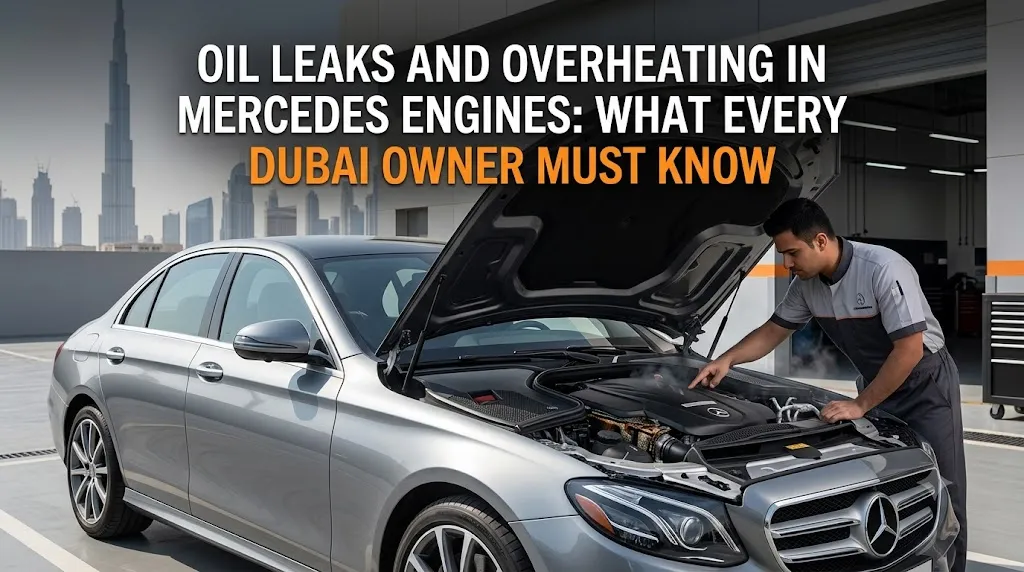
Two problems account for a remarkable share of serious Mercedes engine work in the UAE: oil leaks and cooling system failures. They are close cousins — both are driven primarily by heat, both start as minor annoyances, and both can escalate into engine-threatening emergencies if ignored. The difference between a AED 800 gasket job and a AED 25,000 engine rebuild is usually nothing more than how early the owner responded. This guide walks through the leak points and cooling weaknesses specific to the Mercedes engines most common on Dubai roads, and explains what proper repair looks like.
Why Gaskets Fail Faster in the Gulf
Every engine seals its oil with dozens of gaskets and seals made of rubber, silicone, and composite materials. These materials age through heat cycling — expanding, contracting, and slowly losing elasticity until they harden, shrink, and crack. A Dubai engine bay experiences more extreme heat cycles than almost anywhere: 48°C ambient summers, long idling with restricted airflow, then blasts of highway cooling. Gaskets that seal reliably for fifteen years in northern Europe commonly begin seeping at seven or eight years here. This is not a defect; it is chemistry meeting climate.
The Classic Mercedes Leak Points, Engine by Engine
M272 and M276 V6 (huge numbers of C, E, S, ML/GLE, GLC models). The valve cover gaskets are the first and most common seep point — look for oil wetness along the cam cover edges and a burning smell after highway runs as drips hit the hot exhaust. More involved is the oil cooler seal failure on these engines: the oil cooler sits in the valley between the cylinder banks, and its seals harden with heat, leaking oil down the back of the engine where it is hard to spot until substantial. The repair requires intake manifold removal, so a wise workshop replaces all valley seals and surrounding gaskets in one operation.
M274/M264 four-cylinder turbo (C200, C300, E200, GLC 200/300). Valve cover and timing case seepage appear with age, and the plastic components of the crankcase ventilation system harden and crack, causing both leaks and vacuum-related rough running. A clogged or failed ventilation system raises crankcase pressure and pushes oil past otherwise healthy seals — always check it when chasing recurring leaks.
M156/M157/M177 AMG V8s. Beyond the usual cover gaskets, these performance engines run hotter still and reward vigilance on every seal. Front and rear main crank seals are bigger jobs, and on hot-V turbo engines, oil weeping near turbochargers deserves immediate attention for fire-safety reasons alone.
Older M112/M113 V6 and V8. These famously durable engines mostly leak from valve covers, the crankcase breather gaskets, and the rear main seal in high age — usually slow seeps that still deserve monitoring.
A note on diagnosis: oil travels. Airflow and gravity carry a high leak down and back, so the wet spot rarely marks the source. Professional practice is to clean the engine, add UV dye to the oil, drive briefly, and inspect under UV light — locating the true origin before quoting a repair. Insist on this; it prevents paying to replace the wrong gasket.
Cooling System: The Other Half of the Story
The cooling system in a Dubai Mercedes operates closer to its design limits than almost anywhere on the planet, and its failure modes cluster in predictable places.
Plastic radiator tanks and hose necks. Modern radiators pair aluminium cores with plastic end tanks. Years of pressure and heat make the plastic brittle; failures often start as hairline cracks weeping coolant crust (look for white/pink dried residue) and can end with a neck snapping off outright, dumping coolant in minutes.
Water pumps. Bearing and seal wear announce themselves with a weep from the pump’s tell-tale hole, coolant smell, or a faint bearing growl. On many Mercedes engines, some pumps are electronically switched or have plastic impellers that can degrade — reduced flow without total failure, showing up as creeping temperatures in traffic.
Electronically controlled thermostats. Mercedes’ map-controlled thermostats optimise warm-up and efficiency, but age and heat make them stick. Stuck open, the engine runs cool and rich; stuck closed, it overheats rapidly. A thermostat is inexpensive — the consequences of a stuck one are not.
Expansion tanks, caps, and hoses. The pressurised expansion tank is another brittle-plastic candidate, and a worn cap that cannot hold system pressure lowers the coolant’s boiling point precisely when Dubai needs it highest. Hoses harden and their spring-clamp seats deform; any hose that feels crunchy rather than supple is due.
Electric fans and clogged condensers. The radiator breathes through the AC condenser in front of it. A condenser matted with dust, sand, and insects insulates the entire cooling stack — engine temperatures and AC performance fall together. Fan or fan-control failures then remove the safety margin entirely in stop-and-go traffic. Periodic professional cleaning of the front cooling pack is inexpensive and remarkably effective in this climate.
The One Rule That Saves Engines: Stop Means Stop
Modern Mercedes alloy engines have very little tolerance for overheating. If the temperature gauge climbs toward the red or a coolant warning appears: pull over safely, switch off, and do not “just make it home.” Continued driving warps cylinder heads, crushes head gaskets, and can score bores — transforming a AED 300 hose into a five-figure rebuild in the space of ten minutes. Never open a hot expansion tank; scalding coolant under pressure causes serious injuries every summer. Call recovery instead. No journey in Dubai is worth an engine.
What Professional Repair Involves
Quality leak and cooling work shares common standards: genuine or reputable OEM gaskets and coolant meeting Mercedes specifications (MB 325.0/326.0 — never mixed with incompatible types, never diluted with plain tap water beyond an emergency); torque-to-specification assembly, because Mercedes’ alloy castings and stretch bolts punish improvisation; pressure-testing the cooling system and verifying fan operation after any repair; and vacuum-filling the coolant to eliminate air locks that cause phantom overheating after otherwise correct work. When you engage a workshop for mercedes repair dubai needs of this kind, ask specifically how they locate leaks, what parts brands they fit, and whether pressure testing and vacuum filling conclude the job — the answers separate professionals from parts-swappers immediately.
An Owner’s Early-Warning Checklist
Make these thirty-second habits routine: glance under the parking spot for fresh drips; check the oil level monthly (modern engines with slow leaks or consumption give little warning before levels get critical); watch for coolant crust at hose joints and the expansion tank seam; note any sweet coolant smell or burning-oil smell after drives; and treat the temperature display as an instrument to actually read, especially in summer traffic. Report any of these findings to your workshop while they are findings rather than failures.
The Bottom Line
Heat is the tax Dubai levies on every engine, and gaskets and cooling components are where it is collected. Pay the tax in small, scheduled instalments — early gasket replacement, proactive cooling maintenance, clean radiators, correct fluids — and a Mercedes engine will run magnificently for hundreds of thousands of kilometres in this climate. Ignore the early signs, and the same climate collects with interest. The choice, fortunately, belongs entirely to the owner.