
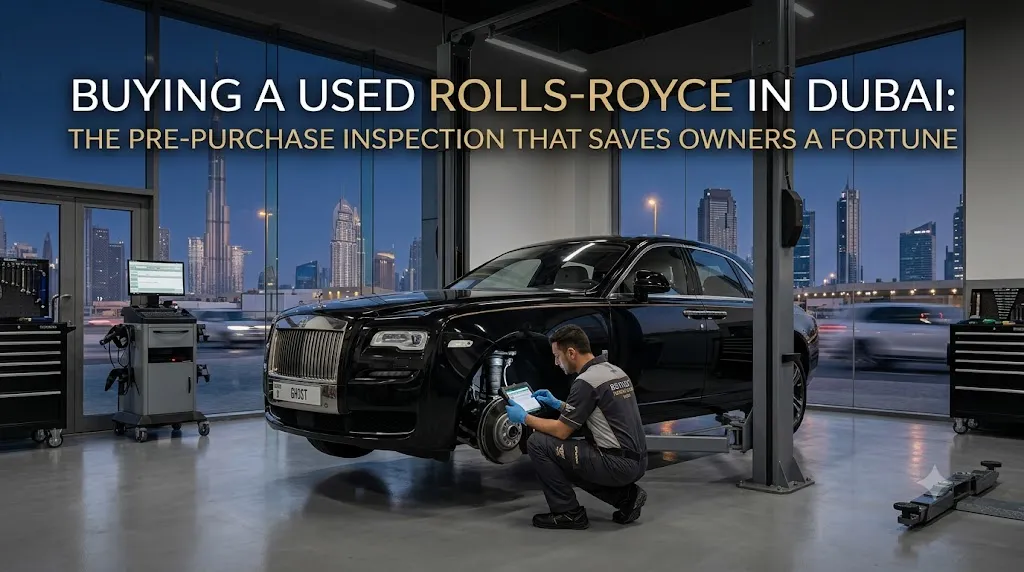
Dubai has one of the most liquid markets for pre-owned Rolls-Royce motor cars anywhere in the world. Ghosts, Wraiths, Dawns, Cullinans, and Phantoms move through dealer showrooms, auction houses, and private sales in numbers few cities can match, and prices — relative to Europe — can look tempting. But the same market conditions that create opportunity also create risk: low-mileage cars that have led hard lives in extreme heat, vehicles with cosmetic restoration masking deferred maintenance, imports with murky histories, and cars whose six-figure purchase price is only the entry fee to ownership.
The difference between a wonderful buy and a financial trap is almost never visible in the showroom. It is revealed by a proper specialist pre-purchase inspection (PPI) — and this article explains exactly what that inspection should cover on a Rolls-Royce in this market, and why skipping it is the most expensive money a buyer will ever “save.”
Why the Dubai Used Market Demands Extra Diligence
Low mileage can mislead. A four-year-old Ghost showing 20,000 km sounds gently used. But if those kilometres were entirely stop-start city traffic in 45°C heat, with the car otherwise baking in outdoor parking, its fluids, rubber components, battery, and air conditioning may be in worse condition than a 60,000 km European car. Conversely, long stationary periods create their own pathology: flat-spotted tyres, seized brake components, degraded fluids, and battery-related electrical gremlins.
Cosmetic restoration is an industry here. Dubai’s detailing and paint sector is world-class, which is wonderful for owners and hazardous for buyers. A car can present with flawless paint and showroom-fresh leather while hiding accident repair, water damage, or a neglected drivetrain. Shine proves nothing.
History can be fragmented. Cars imported from other GCC states, or with service performed across multiple independent workshops, may have gaps no seller can (or will) explain. Some vehicles are re-exported precisely because of problems.
The cost asymmetry is extreme. On a mainstream car, a missed fault might cost a few thousand dirhams. On a Rolls-Royce, a single overlooked system — air suspension, transmission, a corner of the electronics — can present bills of AED 40,000–150,000. A comprehensive PPI costs a rounding error against that.
What a Specialist Pre-Purchase Inspection Must Cover
A genuine Rolls-Royce PPI is a half-day process, not a twenty-minute walk-around. The essential elements:
1. Full Electronic Health Scan
Factory-level diagnostics interrogating every control module — often several dozen — for stored and historical faults. This is the single most revealing step. Fault memory tells stories sellers do not: repeated suspension faults, misfire history, crash-event records in airbag modules, battery-voltage events, mileage cross-checks across modules that expose odometer tampering. A general OBD scanner reading only engine codes misses most of the car.
2. Air Suspension Assessment
Ride-height sensor data at all corners, compressor current draw and run-time, leak-down observation, and a visual inspection of every bellows for the heat-cracking endemic to Gulf cars. Suspension is one of the most common and expensive post-purchase surprises; it must be tested under load, not just looked at.
3. Engine Evaluation Beyond the Idle
Cold-start observation (many faults only appear cold), live data review of fuel trims, misfire counters, and cooling behaviour; borescope inspection of cylinders on higher-mileage or unclear-history cars; pressure testing of the cooling system; inspection for the oil seepage points typical of heat-aged gaskets; and a road test long enough to bring everything to full temperature and load the turbochargers.
4. Transmission Behaviour and Data
Adaptation values read electronically (they reveal clutch wear invisible to a road test), fluid condition assessment where accessible, and a structured road test probing every shift pattern — crawling traffic simulation, rolling kickdown, deceleration downshifts, reverse engagement.
5. Brakes, Tyres, and Chassis
Disc measurement against minimum thickness (replacement discs on these cars are a significant line item), pad life, caliper operation, brake fluid moisture testing, tyre date codes and wear patterns (uneven wear exposes alignment or suspension issues), and inspection of bushings and mounts for heat degradation.
6. Climate System Performance
Vent temperature measurement at all zones front and rear, condenser condition, compressor behaviour, and evidence of recent “quick regas” work that often signals an unresolved leak. In this market, a weak AC system is both common and costly.
7. Body, Structure, and Water Integrity
Paint depth measurement across every panel to map resprays, panel gap and fastener inspection for disturbed assemblies, underbody examination for repair evidence or corrosion, and — critically in a region of occasional flash flooding — inspection for water ingress markers: silt in harnesses, corrosion on seat frames and module pins, moisture staining under carpets. Flood damage is the deadliest hidden defect a luxury car can carry, because it kills electronics progressively for years.
8. Interior Systems — Every Single One
On a Rolls-Royce the interior is much of the value. Every seat function, massage and ventilation, soft-close doors, the Starlight Headliner, all screens and cameras, parking sensors, umbrella housings, rear entertainment, every window, blind, and switch. Small interior faults are individually minor and collectively expensive; a written defect list becomes negotiation leverage.
9. Documentation Forensics
Service records cross-checked against module data, chassis number verification across body and documents, recall status, and — where possible — history checks in origin markets for imported cars.
Reading the Report Like a Buyer, Not a Romantic
No used Rolls-Royce inspects perfectly, and a good PPI is not a pass/fail exam — it is a costed map. The right questions for the specialist afterwards: Which findings are safety-critical? Which are urgent within three months? What is the realistic cost of each item at specialist rates? Which findings suggest a pattern of neglect rather than isolated wear? A car with AED 30,000 of honest, quantified needs and a price adjusted accordingly can be a far better purchase than a “perfect” car with an empty fault memory that was cleared the day before viewing — which, incidentally, a thorough inspector can often detect from module readiness states.
Who Should Perform the Inspection
The value of a PPI is entirely a function of who performs it. It requires factory-grade diagnostic access, model-specific knowledge of where these cars fail in Gulf conditions, and independence from the sale. A seller’s “recent inspection report” is marketing until verified. The buyer’s inspector should answer to the buyer alone.
This is exactly the situation where engaging an established rolls royce specialist dubai before purchase pays for itself many times over — the same workshop that repairs these cars daily knows precisely which model years hide which problems, what each finding costs to put right, and how this particular car compares to the dozens of similar examples they have seen. Many buyers also find that the inspecting specialist becomes their servicing partner after purchase, with the car’s baseline condition already documented.
The Bottom Line
In the Dubai market, a used Rolls-Royce can be exceptional value or an exquisitely upholstered liability, and the showroom lighting will not tell you which. A comprehensive specialist inspection — electronic, mechanical, structural, and documentary — is the only instrument that will. Budget for it as part of the purchase price, insist on independence, and let the data negotiate for you. The best Rolls-Royce purchases in this city are made not with the heart in the showroom, but with a diagnostic report on the table.