
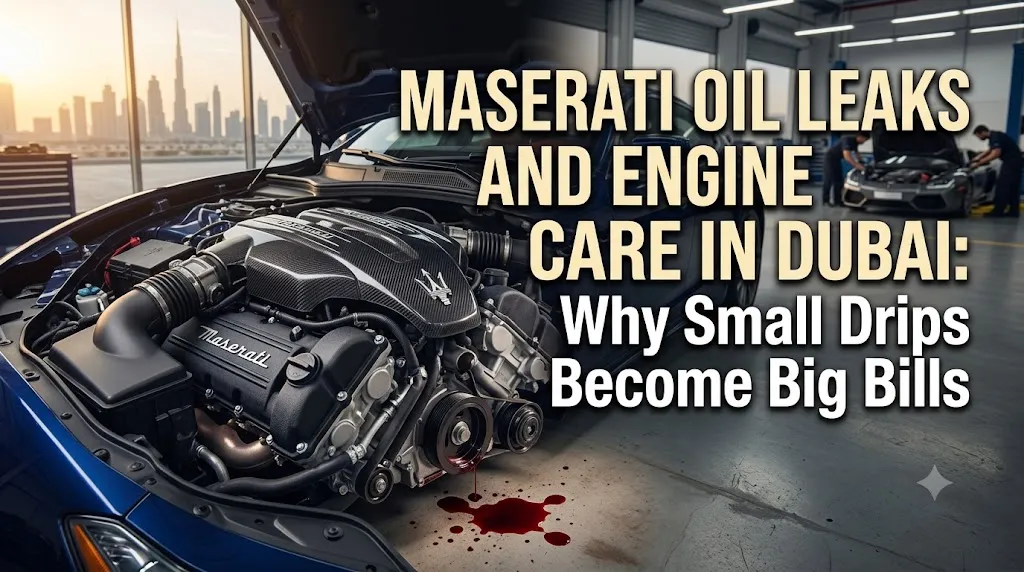
Few things unsettle a Maserati owner like the first oil spot on the garage floor. Sometimes it appears after years of faithful service; sometimes on a car with surprisingly low mileage. In Dubai, oil leaks show up earlier and more often than they do in Europe — not because the engines are fragile, but because the Gulf climate is uniquely hostile to the gaskets, seals, and hoses that keep oil where it belongs.
This guide explains why Maserati engines leak in the UAE, where the leaks come from on the V6 and V8 engines fitted to the Ghibli, Quattroporte, Levante, GranTurismo, and GranCabrio, how to tell a harmless weep from an urgent problem, and how disciplined engine care prevents the truly expensive failures.
Why Dubai Heat Creates Leaks
Every seal in your engine is a piece of rubber or synthetic polymer compressed between two metal surfaces. These materials age through heat cycling: they expand, contract, gradually lose their plasticisers, and harden. A gasket designed to stay supple for fifteen years in a temperate climate can harden in eight or nine in the Gulf, where under-bonnet temperatures routinely exceed anything the European test regime envisioned. Once a gasket hardens, it stops conforming to the surfaces it seals, and oil finds the microscopic gaps. Heat also thins oil, making it more eager to escape, and degrades it faster chemically — which is why oil change discipline and leak prevention are two halves of the same subject.
The Usual Suspects: Where Maserati Engines Leak
Valve Cover Gaskets
The most common leak on the twin-turbo V6 and the V8s alike. The valve covers sit at the top of the engine, exposed to the most heat, and their gaskets harden first. The tell-tale sign is a burning oil smell after driving — oil seeping down onto hot exhaust components — before any drip ever reaches the floor. Left alone, the leak worsens and can contaminate ignition coil wells, causing misfires that owners mistake for a separate problem. Resealing valve covers is routine work for a workshop that knows the engine; the labour lies in careful disassembly and correct torque on reassembly.
Timing Cover and Front Seals
The front of the engine carries the timing cover and crankshaft front seal. Leaks here are more serious to access — on some configurations the work is substantial — and they drip onto the belt drive area, where oil destroys the serpentine belt and can contaminate the alternator. An oily belt squeals, slips, and eventually fails; an alternator soaked in oil follows it. This is the classic example of a small leak causing cascading damage far more expensive than the leak itself.
Oil Cooler and Oil Lines
Turbocharged Maserati engines rely on oil coolers, connected by lines and sealed with O-rings that live in the hottest airflow in the car. Hardened O-rings and weeping line connections are common Dubai findings. Because these components carry pressurised oil, a failure can be sudden and dramatic rather than a slow weep — which is why they deserve inspection at every service, not just when symptoms appear.
Rear Main Seal and Sump Gasket
The rear main seal, where the crankshaft exits to the transmission, and the sump (oil pan) gasket round out the list. The rear main is labour-intensive because the transmission must come out; fortunately genuine rear main leaks are less common than oil migrating from higher leaks above — another reason accurate diagnosis matters before authorising big labour.
Turbocharger Oil Seals
The turbos are fed by engine oil, and their internal seals wear — accelerated by heat, extended oil intervals, and hard driving without cool-down. Worn turbo seals leak oil into the intake or exhaust rather than onto the floor: the symptom is blue-grey smoke on acceleration and unexplained oil consumption with no visible external leak.
Weep, Leak, or Emergency? Reading the Severity
Not every trace of oil is urgent, and overreacting is as costly as ignoring. A useful hierarchy:
- Weep: a damp film on a gasket edge, no drips, stable oil level between services. Monitor it, note it in the service history, plan the reseal at a convenient service.
- Leak: visible drips on the floor, oil level dropping noticeably between changes, burning smell. Book a proper diagnosis soon — and identify the source before oil spreads and disguises its origin.
- Emergency: rapid loss, oil pressure warning, smoke from the engine bay, oil on exhaust components producing visible smoke. Stop driving. An engine run low on oil, even briefly, can suffer bearing damage that turns a gasket job into an engine rebuild.
One diagnostic note: oil travels. Airflow under the car smears oil rearward and sideways, so the wet area is often far from the source. Professional workshops clean the engine, add UV dye if needed, and re-inspect after a drive — a discipline that prevents the expensive mistake of resealing the wrong component.
Oil Changes: The Cheapest Engine Insurance in Dubai
Everything above connects back to oil quality. In the UAE, oil degrades faster (heat oxidation), works harder (turbo bearings, cooling pistons), and faces more contamination (dust, short-trip fuel dilution). Extended 15,000 km intervals that may be acceptable in Europe are risky here. The Dubai discipline is:
- Change oil every 8,000–10,000 km or annually, whichever comes first
- Use exactly the specified grade and approval — turbocharged Maserati engines are engineered around specific oil standards, and “close enough” is not a specification
- Always use a genuine or OEM-quality filter — a collapsing cheap filter can starve the engine
- Check the level monthly. Some oil consumption is normal on performance engines; the danger is not noticing when normal becomes abnormal
Skipping or stretching oil changes in this climate is directly linked to the most expensive Maserati engine failures: worn timing chains, damaged turbo bearings, and sludged oil passages. Measured against those invoices, disciplined oil servicing is the best money you will ever spend on the car.
Choosing Where the Work Gets Done
Oil system work on these engines rewards experience: knowing which gaskets fail first in Gulf conditions, how to trace a migrating leak correctly, the right torque procedures on aluminium components, and which jobs sensibly combine (if the front of the engine is coming apart for one seal, aged neighbouring components should be replaced in the same labour). A dedicated maserati garage dubai that services these engines daily will diagnose by evidence rather than guesswork, use genuine gaskets and correct-specification oil as a matter of course, and document the work properly for your service history — which protects both the engine and the car’s resale value.
An oil leak on a Maserati in Dubai is not a verdict on the car; it is the climate collecting its predictable toll on rubber and polymers. Catch leaks while they are weeps, keep the oil fresh on Gulf-appropriate intervals, and the magnificent engines Modena builds will run strong for hundreds of thousands of kilometres under even the harshest sun.