
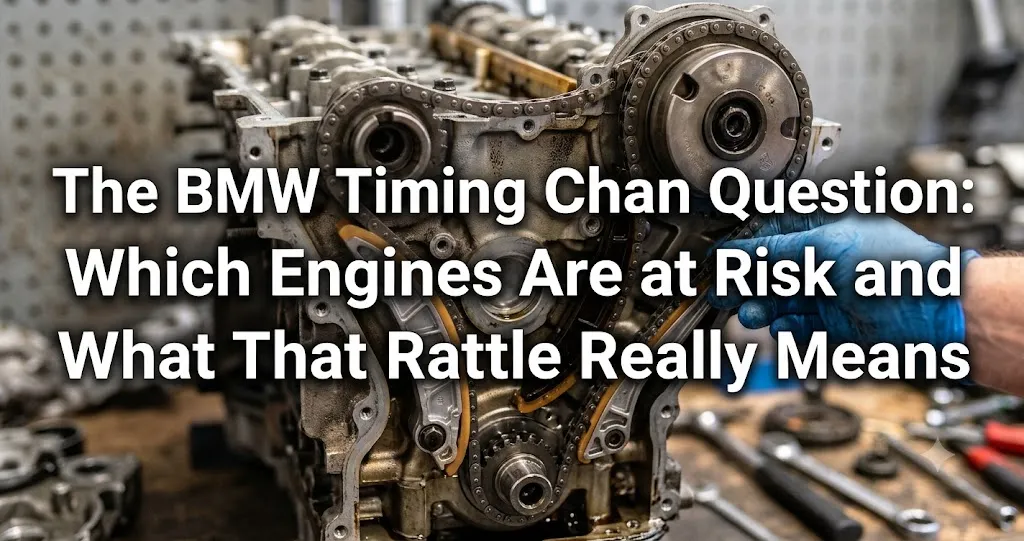
Timing chains were supposed to be the maintenance-free answer to timing belts — fitted for life, never serviced, never thought about. For most engines, that promise holds. But several widely sold BMW engines earned a different reputation, and in the UAE, where heat and long service intervals accelerate every form of oil-related wear, the timing chain question deserves an honest, detailed answer. Because when a timing chain fails, it does not fail politely: pistons meet valves, and a routine repair becomes an engine rebuild.
What the Timing Chain Actually Does
The chain synchronises the crankshaft and camshafts so that valves open and close at precisely the right moment relative to the pistons. BMW engines are interference designs, meaning the valves and pistons occupy the same space at different times — perfect timing is the only thing keeping them apart. The chain is kept taut by a hydraulic tensioner fed by engine oil pressure, and guided by plastic rails. Note both dependencies: the system’s health rests on oil pressure, oil quality, and plastic components — all three of which are stressed harder in Gulf conditions than almost anywhere else.
The Engines With History
N47 four-cylinder diesel (2007–2014-era). The most infamous case. The N47’s chain is mounted at the rear of the engine, against the firewall, and its chains and guides could wear prematurely — with the cruel twist that replacement requires removing the engine, turning a chain job into thousands of dirhams of labour. Diesels are a minority in the UAE market, but imported examples exist, and any N47 with a metallic rustle from the rear of the engine needs immediate attention.
N20 four-cylinder petrol (2011–2017). This one matters enormously in the Gulf, because the N20 powered huge volumes of 320i/328i, 520i/528i, X1, X3, and Z4 models sold here. Early N20 engines (roughly pre-2015 builds) had timing chain guides made of a plastic that becomes brittle, and oil pump drive chain components with their own wear issues. The failure mode is well documented: the guide material cracks, fragments fall into the oil pan, the chain loosens and rattles, and in the worst case the chain skips or the oil pump drive fails — either of which can destroy the engine. BMW revised the components, and later N20s are substantially more robust, but a pre-2015 N20 with unknown history deserves proactive inspection.
N63 V8 (early versions). The twin-turbo V8 in 5.0i-badged X5/X6, 550i, and 650i models had a long list of early-life issues, with timing chain stretch among them, aggravated by high oil consumption — an engine running chronically low on oil accelerates chain wear in a vicious cycle. Later technical updates addressed much of this, but early N63 ownership without maintenance records is a gamble.
B48 and B58 (2015 onward). The current generation of four- and six-cylinder engines has, to date, a far better record. Their chain systems are more robust and failures are rare on maintained engines. “Maintained” is the operative word — no chain design survives neglected oil.
Why Dubai Accelerates Chain Wear
Chain systems live and die by engine oil, and three local factors work against them.
First, oil ages faster here. Sustained high temperatures oxidise oil and deplete its anti-wear additives sooner. BMW’s condition-based servicing can stretch intervals to 15,000 km — calculated on assumptions that do not include four months of 45°C summers. Oil that is chemically exhausted for its last 5,000 km provides measurably worse protection to chain pins, rollers, and tensioner hydraulics. Most independent specialists in the region recommend 8,000–10,000 km intervals precisely because of this.
Second, heat ages the plastic guides. The same heat-embrittlement that cracks expansion tanks and valve covers is at work on the guide rails inside the engine. A guide that stays flexible for 250,000 km in a temperate climate may become brittle earlier here.
Third, traffic patterns matter. Idling in traffic generates low oil pressure at high temperature — the exact condition where a hydraulic tensioner does its weakest work and chains run comparatively slack. Thousands of hours of hot idle add real wear.
The Symptoms: What a Dying Chain Sounds Like
The single most important symptom is a rattle on cold start — a metallic clatter for one to three seconds after the engine fires, before oil pressure builds and the tensioner takes up slack. On its own, a brief cold-start rattle can have innocent causes (VANOS units and tensioner bleed-down among them), but on an at-risk engine, it is the classic first warning.
Other signals: a diesel-like rustle or “sewing machine” clatter that persists at idle and rises with revs; check-engine lights with camshaft/crankshaft correlation fault codes, which mean the timing has physically drifted enough for the sensors to notice; harsh running or misfires accompanying those codes; and, most tellingly, plastic fragments found in the oil pan or filter housing during a service — direct physical evidence of guide breakup.
Modern diagnosis, done properly, does not require opening the engine on a hunch. Camshaft-to-crankshaft correlation values can be read live through diagnostic software and compared against specification — a stretched chain shows up as a timing deviation measurable in degrees. On several engines a visual inspection of the chain and guides is possible through the valve cover or filter housing with a borescope. An experienced workshop combines these checks into a definitive answer for a modest inspection cost, which is vastly preferable to either ignoring a rattle or paying for an unnecessary chain job out of anxiety.
The Repair, Done Right
A proper timing chain repair replaces the system, not the chain alone: chain (or chains — many BMW engines have separate oil pump chains), all guides, the tensioner, sprockets where worn, and the associated seals and gaskets, using current-revision parts that supersede the originals. On engines where the failure sheds plastic, the oil pan comes off and the pickup is cleaned — fragments left behind find their way to the pickup screen and cause oil starvation later. Timing is then set with the proper locking tools; “close enough” does not exist on an interference engine. It is meticulous work, and the difference between a specialist job and a general-garage job shows up two years later.
For owners of at-risk engines — especially early N20s, which are everywhere in the UAE used market — the economics favour prevention. A proactive chain and guide replacement on a healthy engine is a significant but predictable bill. A snapped chain is that bill plus a cylinder head, valves, possibly pistons, and machine work — often exceeding the value of the car. If your BMW has developed a cold-start rattle, or you are buying a used example of one of the engines above, having the timing components inspected and correlation values measured by a dedicated bmw specialist dubai team turns an anxious unknown into a clear, quantified decision.
Conclusion
The timing chain story is not a reason to fear BMW ownership — the majority of BMW engines, including the entire current generation, carry their chains for the life of the car without drama. It is a reason to respect three rules that Gulf conditions make non-negotiable: shorten oil change intervals, never ignore a new cold-start rattle, and know your engine code. Chains almost never fail without warning; they fail after months of warnings that were sufficiently quiet to ignore. In a climate that accelerates every wear mechanism involved, listening early is the cheapest engine insurance there is.