
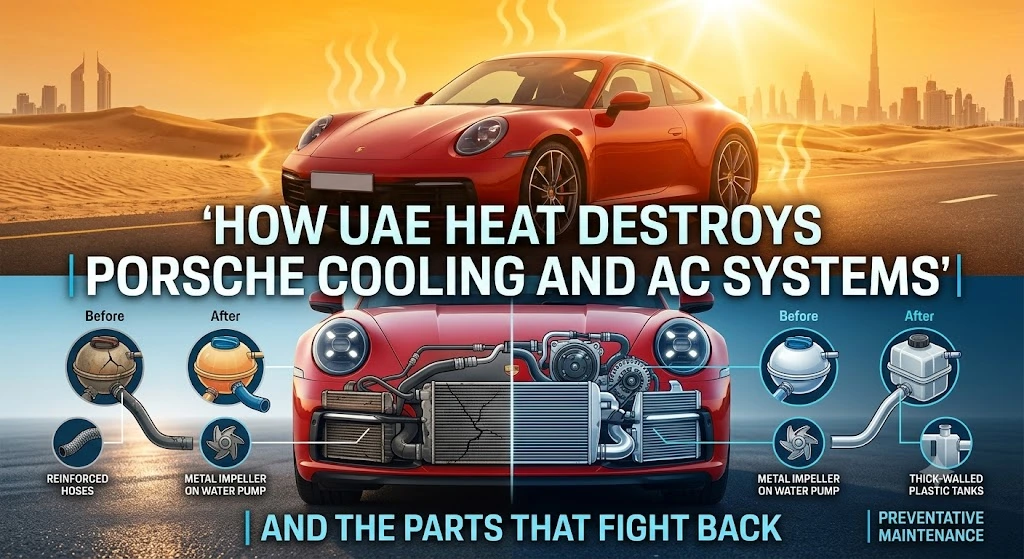
Every Porsche is engineered and tested in extreme conditions before launch, including hot-climate trials. But there is a difference between surviving a validation program and living year after year in an environment where summer asphalt exceeds 60°C, ambient air passes 48°C, and the air conditioning runs at maximum output for six months straight. In the UAE, cooling and climate systems are not comfort features — they are the components that determine whether a Porsche thrives or suffers.
This article explains exactly how Gulf conditions attack Porsche cooling and AC systems across the range — 911, Cayenne, Macan, Panamera, Boxster, and Cayman — which parts fail first, the warning signs, and the maintenance strategy that keeps these cars healthy through the harshest summers.
The Physics of the Problem
Three environmental factors combine against cooling systems in the Emirates:
Sustained high ambient temperature. A cooling system’s job is moving heat from the engine to the air. When the air itself is 47°C, the temperature difference that drives heat transfer shrinks dramatically. Radiators, condensers, and oil coolers must work at or near their design limits for months.
Airborne sand and dust. Fine particles act as an abrasive on the thin aluminum fins of radiators and condensers, slowly eroding them. Dust also packs into the gaps between stacked heat exchangers, insulating them exactly where airflow matters most.
Heat cycling of plastics and rubber. Coolant systems are full of plastic — expansion tanks, pipe fittings, thermostat housings, quick-connectors. Every drive cycle from 25°C garage to 110°C operating temperature stresses these parts, and the deeper cycles of Gulf summers age them roughly twice as fast as European service.
The Porsche Cooling Parts That Fail First in the Gulf
1. Radiators and Condensers
On the 911, Boxster, and Cayman, the radiators sit in the front bumper intakes — directly in the sandblasting zone. On the SUVs and Panamera, the condenser leads the cooling stack and takes the abrasion. UAE workshops routinely see:
- Fin erosion and corrosion from 100,000 km onward
- Leaks at the plastic end-tank crimps, accelerated by heat cycling
- Debris packing between condenser and radiator reducing cooling efficiency by 20–30%
Strategy: Annual cleaning of the cooling stack (professional removal of debris between the heat exchangers) is the single highest-value preventive job for any front-radiator Porsche in the UAE. Replacement radiators and condensers from OEM suppliers such as Nissens, Behr/Mahle, and Valeo restore full capacity at far below dealer pricing.
2. Coolant Expansion Tanks
The pressurized plastic expansion tank is a universal Porsche wear item, and Gulf heat shortens its life. Hairline cracks develop, coolant weeps and evaporates, and the owner notices only a slowly dropping level and an occasional sweet smell.
Warning signs: Coolant top-ups becoming routine, crusty white/pink residue around the tank, low-coolant warnings.
Strategy: Treat any tank over 8 years old in the UAE as due. The part is inexpensive; a collapsed tank on a highway is not.
3. Water Pumps and Thermostats
Porsche water pumps with composite impellers can degrade with age and heat — in the worst cases, impeller fragments circulate through the system. Thermostats stick with age, usually failing partially open (long warmups) or worse, partially closed (overheating).
Strategy: In Gulf service, replace the water pump and thermostat together around 80,000–100,000 km rather than waiting for failure. The parts are moderate in cost, and the labor overlaps completely.
4. Auxiliary Electric Pumps and Fans
Modern Porsches use electric auxiliary pumps to cool turbochargers after shutdown and circulate coolant to the cabin heater core. In turbo cars especially, a failed after-run pump shortens turbocharger life because heat soaks into the bearing housing after every hot shutdown — and every shutdown in a UAE summer is a hot one. Electric cooling fans and their control modules also work far more hours here than anywhere in Europe.
Warning signs: Coolant warnings shortly after shutdown, fans running at full speed constantly, or fans not running when the AC is on.
5. Coolant Pipes and Connectors
Model-specific but critical: the V8 Cayenne and Panamera coolant pipe issues are well documented, and across the range the plastic quick-connectors on coolant lines become brittle. Any coolant smell deserves immediate investigation — in this climate, small leaks become overheating events quickly.
The AC System: The Gulf’s Hardest-Working Components
Compressor
The AC compressor in a UAE Porsche accumulates more running hours in three years than a European car’s does in ten. Failure modes: clutch wear (on clutched designs), internal wear circulating metal debris, and refrigerant leaks at the shaft seal.
Warning signs: Cooling that weakens gradually, intermittent cold air, rattling from the compressor area, the clutch cycling rapidly.
Critical rule: If a compressor fails internally, the system must be flushed and the receiver-drier and expansion valve replaced with it — otherwise debris destroys the new compressor. Denso and Sanden supply OEM-quality units.
Condenser
Doubly stressed: it takes the sand abrasion at the front of the car and works against 48°C ambient air. A condenser at 80% efficiency means an AC system that cannot keep up in August. Replacement before peak summer is one of the smartest scheduled jobs a UAE owner can do.
Blower Motors, Regulators, and Flap Servos
The cabin blower runs at high speed for hours daily. Blower regulators (the electronic speed controllers) are a classic failure across the Porsche range — the symptom is a blower that only works on certain speeds or cuts out. Air distribution flap servos also wear, causing air from wrong vents or clicking behind the dash.
Cabin Filters
In the UAE, the official cabin filter interval is fiction. Desert dust loads filters within 10,000 km, restricting airflow and forcing the blower to work harder. Change cabin filters at every oil service — the cost is trivial and the AC performance difference is immediate.
A UAE Cooling and AC Maintenance Calendar
- Every service: Coolant level and condition, cabin filter, visual leak inspection
- Every year (pre-summer): AC performance test, condenser/radiator cleaning, fan operation check
- Every 2 years: Coolant system pressure test
- Every 4–5 years: Coolant flush with correct Porsche-specification coolant
- 80,000–100,000 km: Water pump, thermostat, drive belt
- Any age over 8 years: Expansion tank, coolant hoses inspection
Sourcing the Parts
All the components above are stocked in depth by the UAE independent market, from the OEM manufacturers who supply Porsche’s own production line. Specialists in porsche parts dubai carry radiators, condensers, compressors, pumps, tanks, fans, and full AC components for every modern Porsche model, with VIN verification to match the exact revision for your car.
Owners anywhere in the Emirates can access the same quality tiers through suppliers of porsche spare parts uae wide, most offering next-day delivery — which matters when summer is approaching and a condenser needs changing before the heat arrives.
Conclusion
Heat is the defining challenge of Porsche ownership in the Gulf, and cooling and AC systems are where that challenge lands. The failure patterns are well understood and entirely manageable: clean the cooling stack annually, replace the known plastic wear items proactively, service the AC before summer rather than during it, and use OEM-quality parts throughout. Owners who follow this playbook drive through August in cold comfort while others queue at workshops. In this climate, cooling maintenance is not an expense — it is the foundation of the entire ownership experience.