
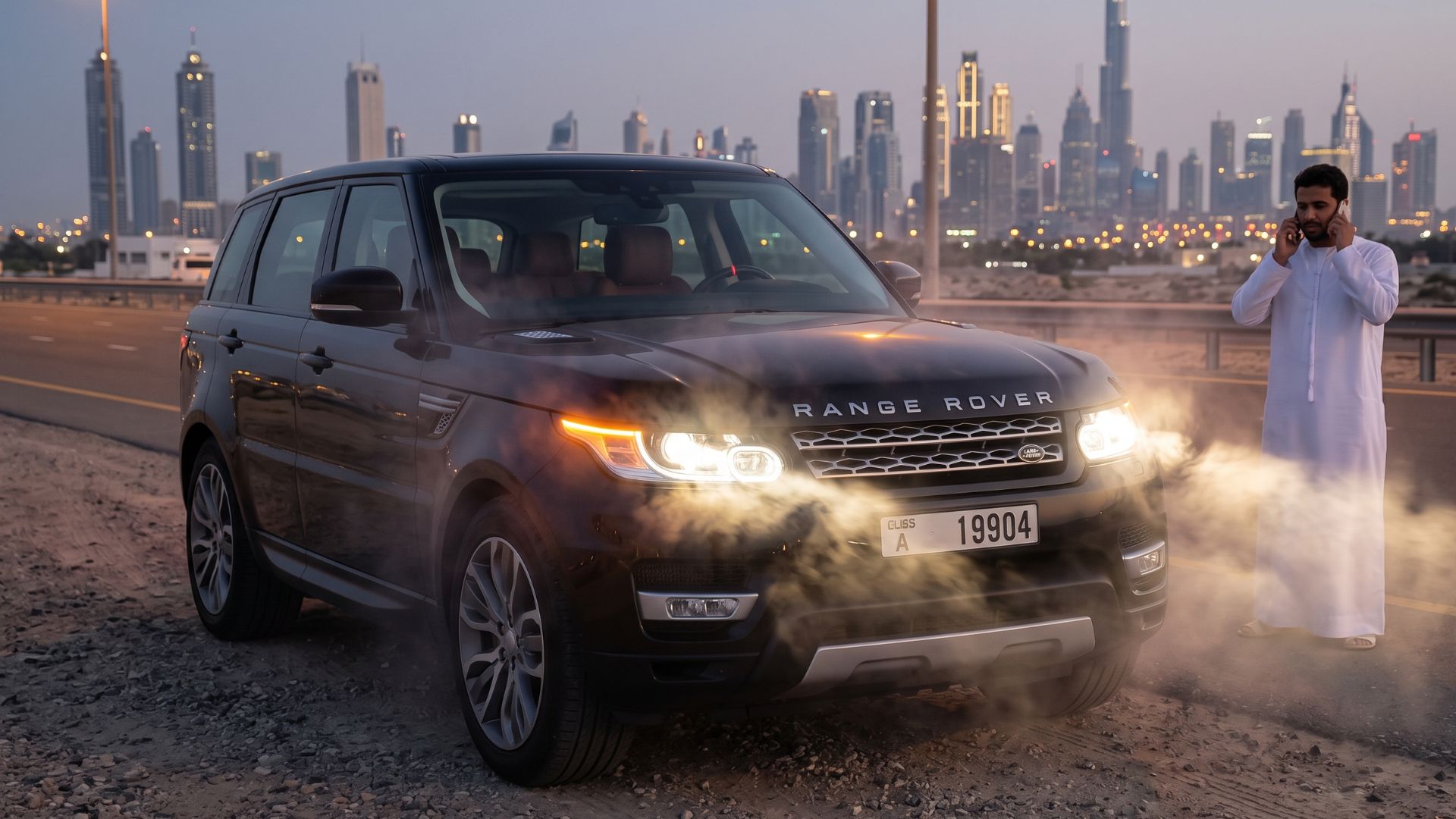
Of all the problems a Range Rover can suffer in Dubai, none is more potentially catastrophic — or more preventable — than engine overheating. The local climate creates a perfect storm of conditions that pushes cooling systems to their absolute limit, and when a Range Rover engine overheats, the repair bills can rival the value of the vehicle itself. Understanding this risk is the single most valuable thing a Range Rover owner in the Emirates can do.
The Physics of the Problem
Every engine produces enormous heat, and the cooling system’s job is to carry that heat away and dissipate it into the surrounding air through the radiator. The effectiveness of this process depends on the temperature difference between the coolant and the outside air. In a European winter, that difference is huge, and cooling is easy. In a Dubai summer, with ambient air already at 45°C or more, the system has almost no thermal headroom. The radiator simply cannot shed heat as efficiently when the air it is rejecting heat into is already scorching.
This means that in Dubai, the cooling system has no margin for error. A weakness that would be a minor annoyance elsewhere — a slightly tired water pump, a marginally blocked radiator, a thermostat that sticks occasionally — becomes a genuine threat to the engine.
Why Range Rover Engines Are Especially Vulnerable
Range Rover and Land Rover engines, particularly the supercharged petrol units, are powerful and run hot by design. Their cooling systems contain a number of plastic components — pipes, housings, and connectors — that become brittle after years of heat exposure and eventually crack. Coolant crossover pipes are a known weak point. Water pumps, which circulate coolant through the system, have bearings and seals that wear and fail. Any of these failures interrupts coolant flow or causes coolant loss, and the temperature climbs rapidly.
Recognising the Danger Signs
- The temperature gauge climbing toward the red zone. The most direct warning, and one that demands immediate action.
- A sweet, syrupy smell. This is the scent of coolant, and it indicates a leak.
- White smoke or steam from under the bonnet or exhaust. A serious sign that coolant is being lost or burned.
- Coolant pooling under the parked car. Look for bright green, orange, or pink fluid.
- The heater blowing cold air. Counterintuitively, a cooling system problem can stop the cabin heater working.
The One Rule That Saves Engines
If your temperature warning light comes on or the gauge enters the red, pull over safely and switch off the engine immediately. Do not try to “just get home.” Continuing to drive an overheating Range Rover, even for a couple of kilometres, can warp the cylinder head, blow the head gasket, or crack the engine block. These are repairs that run into tens of thousands of dirhams. Stopping the engine at the first sign of overheating is free, and it is the difference between a minor repair and a destroyed engine.
Proper Repair and Prevention
A good specialist will not simply top up the coolant and send you on your way. The cooling system should be pressure-tested to find leaks, the water pump and thermostat inspected, the radiator checked for blockages, and the coolant itself evaluated, since old, degraded coolant loses its protective properties and its boiling point drops.
Do not gamble with your engine. Professional Range Rover repair in Dubai can pressure-test the cooling system, replace worn pumps and thermostats, and flush old coolant before a small fault becomes a destroyed engine. Replacing a failing radiator or water pump is far more affordable when you order quality Range Rover parts in Dubai instead of paying inflated dealer prices.
The bottom line: Have your cooling system professionally inspected at the start of every summer. In Dubai, this is not optional maintenance — it is engine insurance, and it costs a tiny fraction of what an overheating event will.