
Bentley Brake Pads and Discs: What Replacement Really Costs in Dubai
Bentley brake pad and disc replacement cost in Dubai comes down to two questions: which axle, and whether the car runs iron or carbon-ceramic discs. This guide covers the squeal that starts it, when the discs have to come off with the pads, indicative cost ranges, and how long pads last in stop-start traffic here.

The Squeal Starts Before the Wear Warning Does
A typical case looks like this: a Continental GT driven mostly around Downtown and Marina starts squealing at low speed, worst on the first few stops of the morning. Nothing on the dash. Two weeks later the pad wear message appears, and by then the friction material is down to a few millimetres and the disc has a lip you can catch a fingernail on.
That gap is normal. Bentley's wear sensor is a wire that only triggers once the pad has already worn past it — and it is a single-use part, so it gets replaced with every pad set. Noise, not the warning light, is your early signal. Bentley has issued technical bulletins acknowledging that brake squeal can occur on the Continental GT even with factory parts, including a specific front squeal when reversing, so noise on its own does not always mean worn out. It does always mean measure.
| What you notice | Most likely cause | What to do now |
|---|---|---|
| Squeal on light braking, cold mornings | Glazed pads, dust or surface rust on discs | Have pad thickness measured; often cleaning and bedding-in only |
| Steady squeal that returns hot or cold | Pad near end of life or wear sensor touching | Book an inspection this week |
| Grinding, metallic scrape | Backing plate on disc | Stop driving it — discs and possibly a caliper are at risk |
| Pedal pulses, steering shimmies under braking | Disc thickness variation or heat distortion | Discs measured for runout and thickness, not just pads |
| Car pulls to one side, one wheel hot | Sticking caliper or seized slider | Caliper service before new parts go on |
Front vs Rear: Where the Money Actually Goes
Fronts do most of the work on a two-and-a-half-tonne grand tourer, so front pads wear first and front discs carry the heat. Rears are cheaper in parts but not always in labour, because the electronic parking brake motors have to be retracted with a diagnostic tool before the caliper will open. Forcing them back by hand damages the actuator — an expensive way to save ten minutes.
Estimate: the ranges below are built from published international retail prices for genuine and aftermarket Bentley brake parts, converted to dirhams, plus an assumed 1.5–2.5 labour hours per axle at a typical Dubai independent specialist rate of AED 250–450 per hour. Indicative only — contact us for an exact quote for your VIN.
| Job (iron brakes) | Typically includes | Estimated Dubai total |
|---|---|---|
| Front pads only | Pad set, wear sensor, clips, hardware clean | AED 1,300 – 2,600 |
| Front pads and discs | Pair of discs, pads, sensor, hub clean-up | AED 4,600 – 6,800 |
| Rear pads only | Pad set, sensor, EPB retraction and reset | AED 1,300 – 2,200 |
| Rear pads and discs | Pair of discs, pads, sensor, EPB reset | AED 3,000 – 4,500 |
| All four corners, pads and discs | Complete refresh, fluid usually advised | AED 7,500 – 11,000 |
Carbon-ceramic is a different conversation. Published retail for a single genuine CSiC front disc runs from roughly AED 20,000 upwards, with ceramic pad sets alone starting around AED 5,000 per axle. Assuming a car needs both front discs and pads, the parts bill on its own can reach five figures before labour. That is why ceramic-equipped cars are almost always kept on ceramic pads and existing discs for as long as the discs measure within tolerance.
Do the Discs Have to Be Replaced With the Pads?
No. On a car that has had one previous pad change and sensible use, iron discs often carry a second set of pads. Replace the discs when at least one of these applies:
- Measured thickness is at or near the minimum stamped on the disc, or will reach it before the new pads wear out.
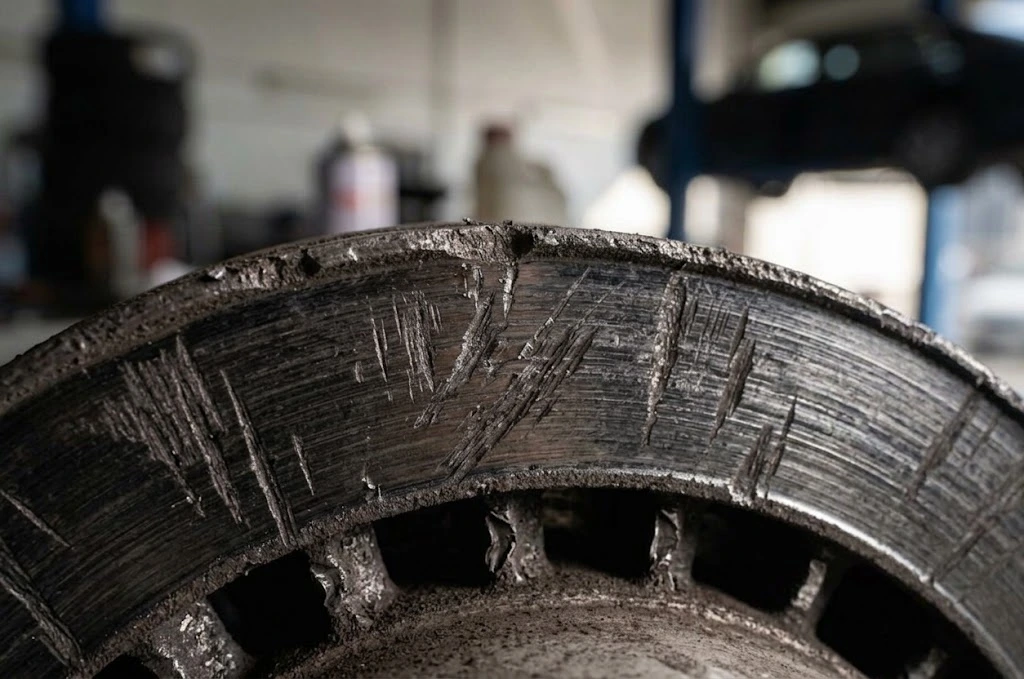
- There is a pronounced wear lip at the outer edge, so a new pad cannot sit flat on the full friction face.
- Heat cracks, deep scoring or blueing across the face.
- Corrosion pitting on the inner face — common on Bentleys that sit for long periods, and a recurring complaint on UK and UAE owner forums where a seized caliper piston stops the inner pad wiping the disc clean.
- Judder under braking that survives a caliper service.
For most owners, we would not skim or machine Bentley discs. They start thick but the usable margin is small, and a skimmed disc on a heavy car tends to come back as judder within a year. Replace in axle pairs, never one side, and change the brake fluid at the same visit if it is over two years old — hot Dubai brakes and moisture-laden fluid are a poor combination.
How Long Bentley Brake Pads Last in Dubai Stop-Start Traffic
Mileage figures from Europe do not transfer well here. UAE summer air regularly passes 45°C, so brakes start every stop hotter; airborne sand adds abrasive wear; and stop-start crawling on Sheikh Zayed Road or Al Khail puts far more braking events into every kilometre than open-road driving. Cars parked for the summer while owners travel come back with surface-corroded discs, and sometimes a dragging caliper that chews a pad set in weeks.
Typical estimates for iron brakes, based on usage pattern rather than age:
| Use pattern | Front pads | Rear pads | Front discs |
|---|---|---|---|
| Mostly city, heavy stop-start | 20,000 – 35,000 km | 30,000 – 45,000 km | 2 pad sets, sometimes 1 |
| Mixed city and highway | 30,000 – 50,000 km | 45,000 – 65,000 km | 2 pad sets |
| Mainly highway cruising | 45,000 – 70,000 km | 60,000 – 80,000 km | 2 – 3 pad sets |
| Low annual mileage, parked often | Age and corrosion decide, not distance | Same | Often discs first |
Carbon-ceramic discs are a different curve again: owners commonly report them lasting the life of the car in street use, with pads the consumable. Isolated forum reports of cracked ceramic discs at low mileage exist, which is why a visual ceramic inspection belongs in any pre-purchase check on a GT Speed or Bentayga with the ceramic option.
Bentley Brake Questions Dubai Owners Ask
Do the discs always need replacing with the pads?
No. Discs are replaced on measurement, not on principle. If thickness is comfortably above the minimum stamped on the disc and the face is smooth with no significant lip, a new set of pads can run on the existing discs. Discs go when they are near minimum, lipped, cracked, deeply scored or pitted from corrosion.
How long do Bentley brake pads last in Dubai?
As a typical estimate for iron brakes, front pads last around 20,000 to 35,000 km in heavy stop-start city use and 45,000 to 70,000 km on mainly highway driving. Rear pads generally last longer. On low-mileage cars that sit for months, corrosion and caliper drag usually decide replacement before wear does.
Can Bentley brake pads and discs be done in a day?
In most cases yes, when the parts are on the shelf. A single axle is usually a same-day job, and all four corners can often be completed in a day. The variable is parts supply: genuine items for older or rarer models may need ordering, and carbon-ceramic discs are typically special order. We offer free pickup and drop-off anywhere in Dubai, so the car does not need driving in.
Are aftermarket brake pads safe on a Bentley?
Quality aftermarket pads from a recognised manufacturer are a reasonable choice on iron brakes and cost noticeably less than genuine. The trade-offs are more noise and dust with some compounds, and mismatched pad-disc pairings are a known cause of squeal. Carbon-ceramic systems are the exception — those should stay on the correct ceramic-specification pad.
Why do new Bentley brakes squeal?
Usually bedding-in, missing or reused anti-rattle hardware, or a pad compound that does not suit the disc. Bentley has published bulletins acknowledging that squeal can occur on the Continental GT with factory parts, so it is not automatically a fault. If it persists past a few hundred kilometres, the hardware and pad choice should be reviewed rather than ignored.
Get the Brakes Measured Before They Turn Into a Disc Job
Send us your model, year and mileage and we will tell you what to expect — with free pickup and drop-off across Dubai.